SEFROU & BHALIL
Séfrou and bhalil This ancient town has always stood in the shadow of Fès, the imperial capital. It takes its name from the Ahel Séfrou, a Berber tribe that was converted to Judaism 2,000 years ago, and that was then Islamized by Idriss in the 8th century.
In the 12th century, trade with the Sahara brought Sefrou prosperity. A century later, it became home to a large colony of Jews who had fled from the Tafilalt and southern Algeria. In 1950, a third of Sefrou’s population was Jewish.
The majority of Jews emigrated to Israel in 1967, and the town’s population is now mostly Muslim. Séfrou is surrounded by crenellated ramparts pierced by nine gates. These ochre pisé walls have been restored on several occasions, The town is bisected by Wadi Aggai, which irrigates the surrounding fertile plain.
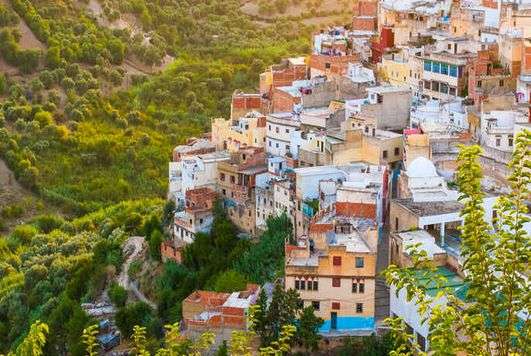

Four bridges link the two parts of the town. South of the wadi is the mellah, the former Jewish quarter, a district of narrow winding streets, North of the wadi is the old medina, with its souks centered around the Grand Mosque and the zaouia of Sidi Lahcen Lyoussi, who became patron saint of Séfrou in the 18th century.
On the north side of the town, outside the ramparts, is a crafts centre where leather goods, pottery and wrought-iron items are made. The Cherry Festival, marking the end of the cherry harvest in June, is a major event in the town, which is surrounded by cherry orchards.
The festival goes on for several days, and the major event is a grand procession marked by the coronation of the Cherry Queen. Folk dancers and musicians from the Middle Atlas, Fès and the Rif perform and there are sometimes fantasias.
The road following the river upstream for 1 km (0.6 mile) west of Séfrou leads to the Kef el-Moumen Caves, natural caves in the cliff face containing tombs that are venerated by Muslims and Jews. One of them is said to be that of the prophet Daniel.
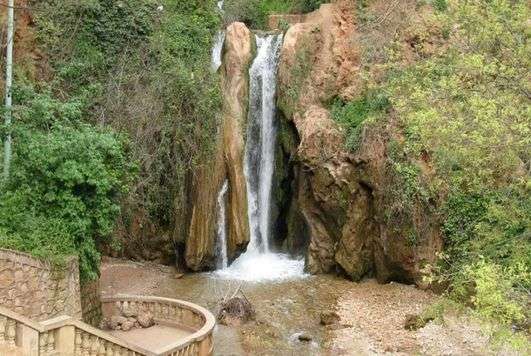
The Wadi Aggaï Falls here bring a welcome freshness to the surrounding hills. The green-roofed Koubba of Sidi bou Ali Serghine, 2 km (1 mile) west of Séfrou, offers a scenic view over Séfrou and the Kandar hills. Nearby is the miraculous spring of Lala Rekia, which is reputed to cure madness.
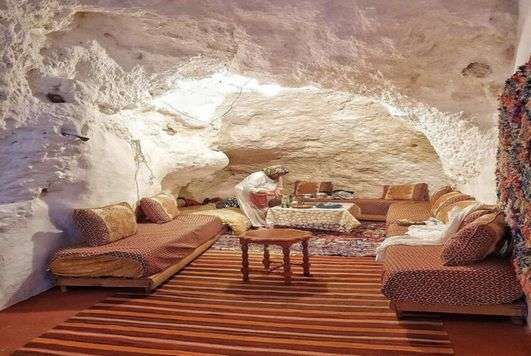
The village of Bhalil, 7 km (4 miles) north of Sefrou, has troglodytic dwellings. Its d population, Christian during the Roman period, was converted to Islam by Idriss Il A minor road east of Sefrou leads to the small town of El-Menzel. The kasbah here overlooks the Sebou Gorge, which has impressively sheer cliffs.