okimden
A ski resort in winter and base for mountain hikes in summer, Oukaïmeden is a haven of fresh air, just over one hour from Marrakech.
The resort is easilyreached on a road that forks off to the right at the village of Arhbalou, with the Ourika valley on the left. Shaded by olive, oak and walnut trees, the road then winds upwards in a series of hairpin bends through a stony landscape.
The chalets and winter sports facilities are in the village itself, encircled by mountain peaks: Jbel Oukaimeden, rising to a height of 3,273 m (10,742 ft) Jbel Ouhattar, at 3,258 m (10,693 ft), and Jbel Angour, at 3,614 m (11,861 ft).
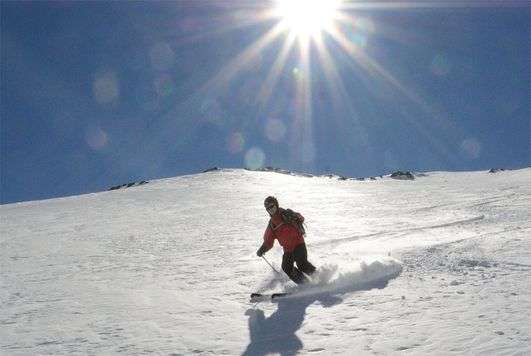
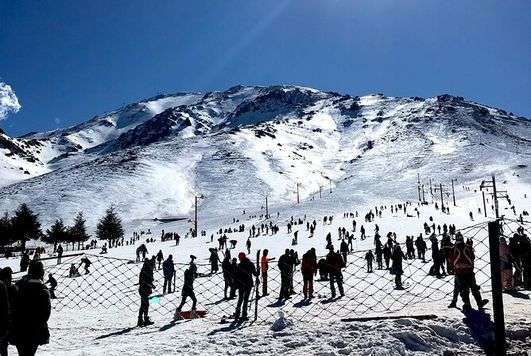

The great Oukaimeden plateau is carpeted in pasture, the grazing of which is controlled by tradition. From November to April, if the snow is sufficiently deep, a chair lift – the highest in North Africa – runs up to the summit of Jbel Oukaimeden, while several ski lifts allow beginners to practise on the lower slopes.
The resort also offers long-distance and cross-country skiing. Rock engravings can be seen in the village and on the plateau. Dating from the Bronze Age, they depict mainly daggers, halbards, shields and humans.
About 2 km (1 mile) from the resort, the site of a transmission mast at an altitude of 2,740 m (8,993 ft) commands a magnificent view of the Atlas and the plain where Marrakech is located.
In summer, Oukaïmeden is also the starting point for mountain hikes, particularly up to the Tizi-n-Ouaddi Pass, the beautiful village of Tacheddirt, and to Imlil and the Tizi-n-Test Pass.
Exploring THE HIGH ATLASS
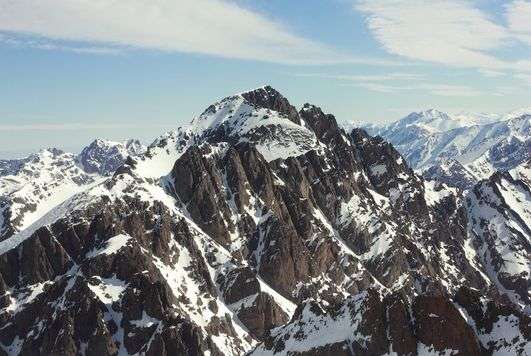
Crowned with high peaks, the chain of the High Atlas culminates in the west in Jbel Toubkal. At 4,167 m (13,676 ft), this is the highest peak in North Africa, with pisé villages nestling on its lower slopes. In the centre, Jbel M’Goun, at 4,068 m (13,351 ft), rises over the Tessaout, Ait Bouguemez and Aït Bou Oulli valleys. The only channels of communication between these valleys are mule trails and high passes.
On the banks of the wadi that snakes along the valley bottoms, villages cluster around fortified houses, punctuating expanses of cultivated land. The eastern end of the High Atlas is marked by the imposing outline of Jbel Ayachi, 3,737 m (12,265 ft) high. Here high desert plateaux stretch to the horizon. From late spring to early autumn they are filled with flocks of grazing sheep.
Jbel Toubkal Tour
Tour of the Jbel Toubkal Massif As well as the opportunity to climb to the top of Jbel Toubkal, at 4,167 m (13,676 ft) the highest peak in the Atlas, the Jbel Toubkal massif offers great scope for hikes lasting several days. Climbing Toubkal is not particularly difficult, but the fact that it is a high-altitude hike over rough terrain should be taken into account. From the Toubkal Refuge, the summit of Jbel Toubkal can be reached in about four hours. For the finest view over the High Atlas, it is best to reach the summit in the late morning.
Imlil
Surrounded by walnut and fruit trees, this mountain village is the starting point for the climb up Ibel Toubkal and also for many other mountain hikes.
Aremd
The village in the Mizane valley, lies at 1,900 m (6,236 ft), Its stone houses cling to the rocky mountainside, surrounded by cultivated terraces.
Jbel Toubkal
You can climb to the top at the end of winter: it offers breathtaking views over the whole of High Atlas.
Toubkal Refuge
This is the last stopping place before the summit of Jbel Toubkal. The refuge, at 3,200 m (10,502 ft), is open all year-round.
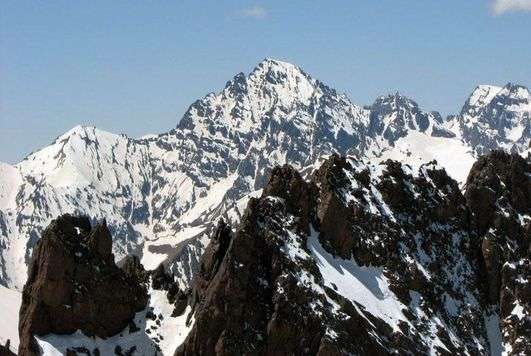
Lepiney Hut
Located at the start of the hike up the Azzaden valley and across the Tazarhart plateau, at 3000 m (9,846 ft), the hut is used by seasoned hikers and rock climbers.
Sidi Chamharouch
At the end of a deep gorge, the koubba of Sidi Chamharouch, king of the djnouu (genies), attracts pilgrims all year-round.
Lake Ifni
The lake, five hours’ walk from Toubkal Refuge, lies in a mineral-rich environment. Shepherds’ huts stand on the lakeshore.
Tacheddirt
This pretty village, at 2314 m (7,595 ft) and set amid mountains, is reached via the Tizi n-Tamatert Pass, east of Imlil.
Mountains Tour
The Mountains of Morocco From the high peaks down to altitudes above 600 m (1,970 ft), the climate is permanently moist. Annual precipitation ranges from 650 mm (25 in) in the eastern Grand Atlas to over 2 m (80 in) in the Rif, and snowfall is often heavy. The vegetation in this band is particularly luxuriant, and many forests thrive in this well-watered environment. The forests consist mostly of cedar, cork oak, deciduous oak, evergreen holm-oak and, in the Rif, Moroccan pine.
Imlil
Surrounded by walnut and fruit trees, this mountain village is the starting point for the climb up Ibel Toubkal and also for many other mountain hikes.
Aremd
The village in the Mizane valley, lies at 1,900 m (6,236 ft), Its stone houses cling to the rocky mountainside, surrounded by cultivated terraces.
Jbel Toubkal
You can climb to the top at the end of winter: it offers breathtaking views over the whole of High Atlas.
Toubkal Refuge
This is the last stopping place before the summit of Jbel Toubkal. The refuge, at 3,200 m (10,502 ft), is open all year-round.
Lepiney Hut
Located at the start of the hike up the Azzaden valley and across the Tazarhart plateau, at 3000 m (9,846 ft), the hut is used by seasoned hikers and rock climbers.
Sidi Chamharouch
At the end of a deep gorge, the koubba of Sidi Chamharouch, king of the djnouu (genies), attracts pilgrims all year-round.
Lake Ifni
The lake, five hours’ walk from Toubkal Refuge, lies in a mineral-rich environment. Shepherds’ huts stand on the lakeshore.
Tacheddirt
This pretty village, at 2314 m (7,595 ft) and set amid mountains, is reached via the Tizi n-Tamatert Pass, east of Imlil.