EL JADIDA
El Jadida’s old city sea walls are one of the Seven Wonders of Portuguese Origin in the World. The Portuguese Fortified City of Mazagan was registered as a UNESCO World Heritage Site in 2004, on the basis of its status as an “outstanding example of the interchange of influences between European and Moroccan cultures” and as an “early example of the realisation of the Renaissance ideals integrated with Portuguese construction technology”.
The city, and particularly its neighboring town of Sidi Bouzid, becomes extremely busy in the summer season with an influx of mainly Moroccan holiday-makers.
Nearby is the five-star resort complex of Mazagan, which attracts some middle-class Moroccans as well as many international visitors from the Arabian Peninsula as well as from Europe and beyond. Mazagan complex has a golf course designed by Gary Player, casino, nightclub and restaurants.
Between Mazagan complex and El Jadida is the Pullman Hotel, attached to which is Royal Golf El Jadida, another 18-hole course.
Exploring EL JADIDA
The Portuguese settled here in 1502 and built a fort that they named Mazagan. In time, the town became a major centre of trade, and ships from Europe and the East anchored here to take on provisions. In 1769, the sultan Sidi Mohammed expelled the Portuguese, who dynamited it as they fled.
It was resettled by local Arab tribes and a large Jewish community from Azemmour at the beginning of the 19th century. The town was then known as El Jadida (The New One), but temporarily reassumed its original name – Mazagan – under the French Protectorate.
Ramparts
Ramparts Entry into the old town is through a gateway that leads to Place Mohammed benAbdallah. The walls were originally fortified with five bastions but only four of these were rebuilt after the Portuguese had destroyed the town as they escaped Sidi Mohammed in 1769.
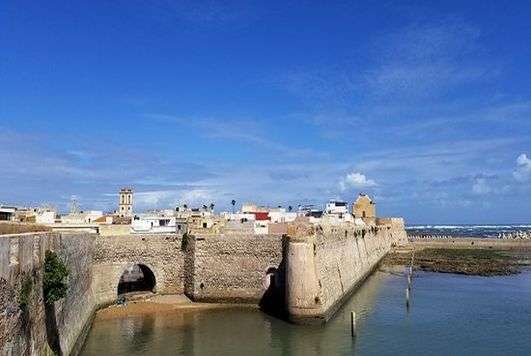
The rampart walk leads to the Bastion de l’Ange, which commands a panoramic view over the old town. The Bastion de St Sébastien was once the seat of the Inquisition’s tribunal and the prison.
Old Medina
Medina The main street leads to the sea gate (Porta do Mar), from where there is access to the rampart walk. This gate, now blocked in, once linked the town to the seashore.
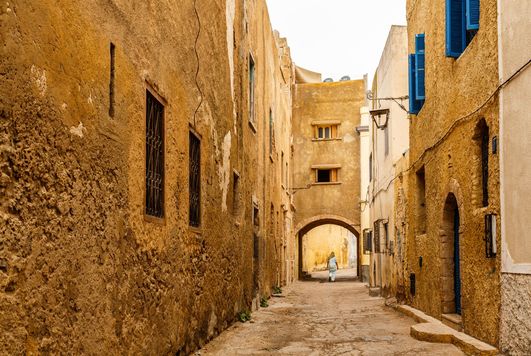
Halfway along the main street is the entrance to the Citerne Portugaise, originally an underground arsenal, which is one of El-Jadida’s most interesting sights and should not be missed. The mellah has a deserted air: most of the Jewish community emigrated to Israel in the early 1950s.
Portuguese Cistern
Citerne Portugaise Open 9am-1pm & 3-6pm daily This former armoury, in the Manueline Gothic style, was converted into a cistern after the cradel was enlarged in 1541.

It was then constantly fed by fresh water so as to quarantee the town’s water supply in the event of a prolonged siege Rediscovered by chance in 1916 when a shopkeeper was knocking down a wall to enlarge his shop, it has fascinated many artists as well as visitors. Orson Welles used it as a location for certain scenes of his film Othello, released in 1952.
Azemmour
Azemmour An ancient Almohad town located on the left bank of the Wadi Oum er-Rbia estuary.
Azemmour is also known by the name of Moulay Bouchaib the town’s patron saint, who, in the 12th century, was also patron saint of the trade that then flourished between the town and Málaga, in Spain.

In 1513, the Portuguese took control of the town. The fort that they built became the kasbah that can be seen today They abandoned the town when Agadir fell in 1541.
The narrow white streets of the medina are peppered with architectural features recalling the former Portuguese presence the style of the doors being particularly prominent in this respect.
The town also has a tradition of Portuguese-style embroidery, which features dragons and lions depicted face to face, an exclusively Moroccan motif.
The mellah (Jewish quarter), once within walls, is now derelict. The synagogue, however, has a notable pediment with an inscription in Hebrew.
Oualidia
Oualidia This small coastal resort takes its name from the sultan El-Oualid, who built a kasbah here in 1634 The rather unattractive town centre leads through to a stunningly beautiful beach on the edge of a lagoon Swimming is safe here but on either side, the sea is rough and foaming.
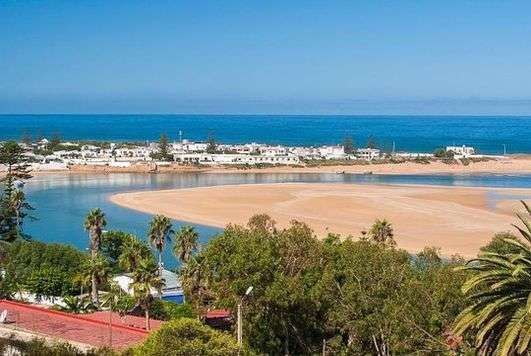
This is one of the beaches on the Atlantic coast that is good for surfing, particularly for beginners. Among the summer villas here is the residence built for Mohammed V The town is an important centre of the oyster industry. A visit to the oyster farms (parcs à huitres), particularly Oyster Farm N° 7 – including the opportunity to sample some oysters – is a pleasant way to pass some time.