Meknes & volubilis
MEKNÈS & VOLUBILIS Located between the fertile plain of the Rarb and the Middle Atlas, Meknès and Volubilis lie at the heart of an agricultural area that has been Morocco’s grain store since ancient times. The historical importance of the two cities can be clearly seen in the ruins of Volubilis, capital of Mauretania Tingitana and the most important archaeological site in Morocco, as well as in the grandeur of the Moorish buildings in Meknès.
From the time of its foundation in the tenth century to the arrival of the Alaouites in the 17th century, Meknès was no more than a small town overshadowed by Fès, its neighbour and rival. It was not until the reign of Moulay Ismail, which began in 1672, that Meknès first rose to the rank of imperial city.
With tireless energy, the sultan set about building gates, ramparts, mosques and palaces. This ambitious building programme continued throughout his reign and involved robbing the ruins of Volubilis and the Palais el-Badi in Marrakech. After 50 years, work was still not completed. Although the sultan’s impatience was often a hindrance, he reinvigorated palace architecture. Today, Meknès is one of the largest cities in Morocco, with a population approaching a million. After 50 years, work was still not completed. Although the sultan’s impatience was often a hindrance, he reinvigorated palace architecture.
Today, Meknès is one of the largest cities in Morocco, with a population approaching a million. It is a dynamic economic centre, renowned for its olives, wine and mint tea. The imperial city stands alongside the new town, on the banks of Wadi Boufekrane.
Exploring Meknès
Three well-defined quarters – the medina, the imperial city and Ville Nouvelle (the New Town) – make up the city of Meknès. The medina is a densely packed quarter. The kasbah, or imperial city, contains the finest of the lavish buildings constructed Moulay Ismail. Ville Nouvelle is located on the east bank of Wadi Boufekrane.
Ramparts
Encircling the medina, Meknès, Protected by three stretches of wall that together amount to about 40 km (25 miles), the medina has the appearance of a sturdy fortress set with elegant gates.
Bab el-Berdaïne (Gate of the Pack-Saddle-Makers), on the northern side, was built by Moulay Ismail. It is flanked by protruding square towers crowned by merlons, and stylized flowers in zellij tilework decorate its exterior façade.

West of the gate, the walled cemetery contains one of the most highly venerated mausoleums in Morocco – that of Sidi Mohammed ben Aïssa, founder of the brotherhood of the Aïssaoua
On the southern side of the cemetery stands Bab el-Siba (Gate of Anarchy) and Bab el-Jedid (New Gate, although in fact it is one of the oldest in Meknès). Further south is Bab Berrima, which leads into the medina’s principal souks.
To the west stands Bab el-Khemis (Thursday Gate), which once led into the mellah, now nonexistent. The remarkable decoration of the gate’s façade is on a par with that of Bab el-Berdaïne.
The layout of the medina, a medieval labyrinth, is identical to that of the other imperial cities. There are a few main thoroughfares. Rue Karmouni, which runs through the quarter from north to south links Bab el-Berdaïne with the spiritual and economic heart of the medina, Rue des Souks runs from Bab Berrima, in the west, also to the heart of the medina.
Several smaller streets radiate from this centre, which is marked by the Grand Mosque and the Bou Inania Medersa.
Souks & Kissaria
A network of small covered or open streets lined with shops and workshops, the souks are a fascinating encapsulation of the 17th- and 18th-century Moroccan urban environment.
Rue des Souks, near Bab Berrima, is filled with hardware merchants (akarir), corn chandlers (bezzazine), and fabric sellers (serrayriya), while metalsmiths (haddadin) are to be found in the old Rue des Armuriers Bab Berrima leads through to Souk En-Nejjarine, the Carpenters’ Souk, which is next to that of the brass and coppersmiths, and to the Cobblers’ Souk (sebbat).
The En-Nejjarine Mosque, built by the Almohads in the 12th century, was restored by Mohammed ben Abdallah in about 1756, when it was given a new minaret. Set back from the En-Nejjarine Souk, in the Ed-Dlala Kissaria, is the location of a Berber souk.
Every day from 3pm to 4pm, the mountaindwellers of the Middle Atlas come to sell carpets and blankets here at auction.

The Grand Mosque
Which stands near the souks and the Bou Inania Medersa, was established in the 12th century during the reign of the Almoravids. It was remodelled in the 14th century. The main façade is pierced by an imposing doorway with a carved awning.
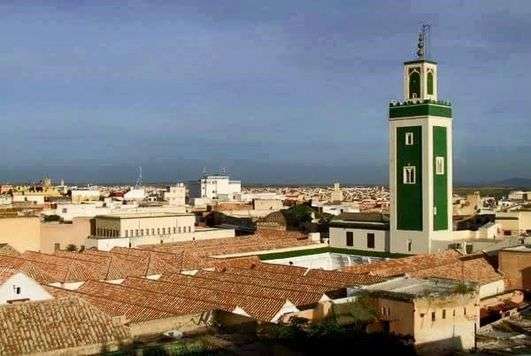
The green-glazed terracotta tiles of the roof and of the 18th-century minaret are particularly striking, the bright sunlight giving them an almost translucent appearance, The Palais el-Mansour, a sumptuous 19th-century residence in Rue Karmouni, has been converted into a carpet and souvenir bazaar.
Bou Inania Medersa
Rue des Souks es Sebbat, Meknès. Open 8am-noon, 3-6pm daily. This Koranic school opposite the Grand Mosque was established by the Merinid sultans in the 14th century.The building is divided into two unequal parts with a long corridor between them. On the eastern side is the medersa proper, while on the western side is an annexe for ablutions (now no longer in use).
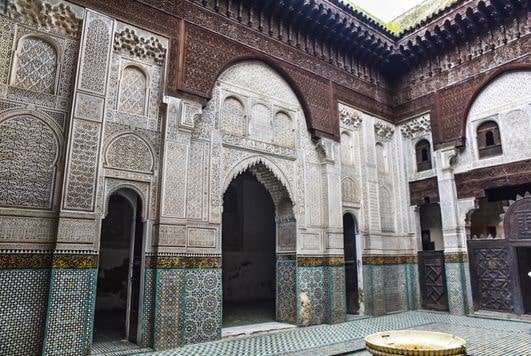
The main entrance is crowned by a flat-sided dome and faced with horseshoe arches with delicate stuccowork decoration. A corridor leads to a beautiful courtyard in the centre of which is a pool. While three sides of the courtyard are lined with a gallery, the fourth opens onto the prayer hall.
The green-tiled awnings, the sophisticated decoration of carved wood, stuccowork and colourful zellij tilework, as well as the mosaiclike tiled floor make the whole courtyard an entrancing sight.
The prayer hall, with carved stucco decoration and an elegant mihrab within a horseshoe arch, remains unaltered. Students’ cells fill the rest of the ground floor and the upper floor.
The terrace offers a fine view of the medina and the Grand Mosque next to the medersa.
Dar Jamaï Museum
This museum, in which Moroccan arts are displayed, is laid out in a delightful residence built in about 1882 by Mohammed Belarbi el-Jamaï, who was a grand vizier of Moulay el-Hassan in 1873-4.
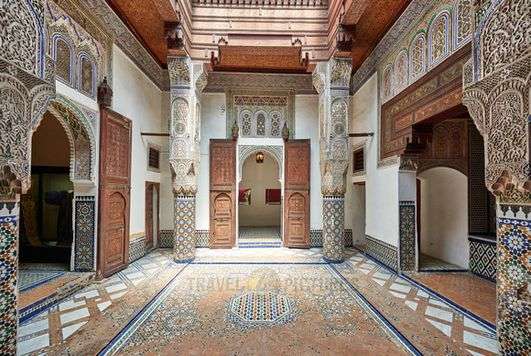
The sophisticated architecture of the palace includes painted wooden cornices, a green-tiled roof and a courtyard with two pools and zellij tilework. There is also an Andalusian garden planted with tall cypresses. Covering 2,845 sq m (30,600 sq ft), the palace also has several annexes and outbuildings.
Bab Mansour el-Aleuj
Bab Mansour el-Aleuj South of the medina, Meknès. Bab Mansour el-Aleuj (Gate of the Victorius Renegade) is named after the Christian who designed and built it.
Standing like a triumphal arch before the imperial city, it pierces the walls of the kasbah and leads through to Place Lalla Aouda and the Dar el-Kebira Quarter Of monumental proportions and distinguished for its decoration.
Bab Mansour el-Aleuj is held to be the finest gate in Meknès, or even in Morocco. It was begun by the sultan Moulay Ismail in about 1672, when the building of the kasbah, his first project, was under way.
The gate was completed during the reign of his son, Moulay Abdallah, in 1732. The gate stands about 16 m (52 ft) high, while the arch has a span of 8 m (26 ft) wide and is surmounted by a pointed horseshoe arch. An intricate pattern of interlacing motifs is carved in relief on a background of predominantly green mosaics and tiles.
The cornerpieces are filled with sgraffito floral decoration incised into dark-glazed terracotta. The gate is framed by protruding towers built in the style of loggias. Temporary exhibitions are sometimes held here.

El Hedime Square
Place el-Hedime (Square of Ruins) links the medina and the kasbah. It was laid out on the ruins of the Merinid kasbah that Moulay Ismail razed to make space for the palaces, water tanks, gardens, stables, arsenals and forts with which he planned to surround himself.

The square has been restored and is now lined with modern residential buildings that are not in keeping with its historic character. Nearby, to the left of the square, is a covered food market.
Habs Qara
This imperial pavilion, also known as the Pavilion of the Ambassadors, was used originally to receive diplomats who came to negotiate, among other things, the ransom of Christian prisoners.
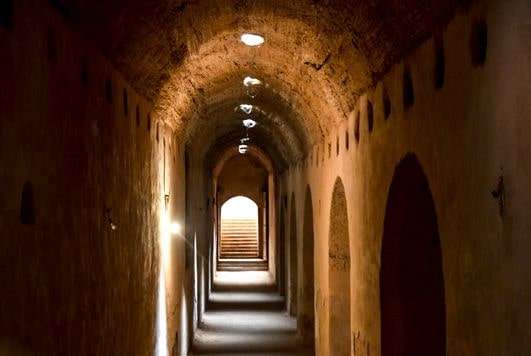
Later, the building was used by tailors (khiyatine), who made military uniforms here. The building is crowned by a conical dome decorated with geometric and floral motifs. Behind the pavilion are the former underground storage areas that were converted into the Christian Prison, or Habs Qara.
The prisoners – probably Europeans captured by the corsairs of Rabat – were made to work on the sultan’s herculean building projects.
Chroniclers recorded that thousands of convicts were incarcerated in these underground galleries, which were later partly destroyed by an earthquake.
Mausoleum of Moulay Ismaïl
A suite of three rooms, 12 columns and a central sanctuary where the great sultan lies, the Mausoleum of Moulay Ismail is in some aspects reminiscent of the Saadian Tombs in Marrakech.
The mausoleum was built in the 17th century and was remodelled in the 18th and 20th centuries. The wife of Moulay Ismail and his son, Moulay Ahmed al-Dahbi, as well as the sultan Moulay Abderrahman (1822-59), are laid to rest in the burial chamber, which is decorated with stuccowork and mosaics.
Entrance
To Mausoleum This imposing carved stone doorway surmounted by an awning and pyramidal tool, indicates the importance of the royal building to which it gives access.
Burial Chamber
This consists of a suite of three rooms, including the ablutions room with central fountain (above) and the room containing the tomb of Moulay Ismail, and those of his wife and sons.
Decorated Door
This carved and painted wooden door between the ablutions room and the second room of the burial chamber is similar to those of the palaces and fine town houses of Meknès.
Prayer Hall
The floor of the prayer hall is covered with mats on which worshippers kneel to pray or to reflect before going into the burial chamber.

Finials
The roof of the mausoleum is topped with five brass spheres indentifying the building as a shrine or sacred place.
Small Courtyards
En route to the burial chamber you pass through several empty courtyards. which are decorated in a sober style. This allows visitors to leave behind them the noise and bustle of the city.
Mihrab
The mausoleum’s mihrab is located in the open courtyard. This unusual position differs from the arrangement at the Saadian Tombs in Marrakech.
Zellij Tilework
The lower part of the walls of the rooms leading into the burial chamber is covered with traditional zelliy tilework, mosaics of glazed polychromne tiles Tomb of Moulay lama Clock presented by Louis XIV.
Courtyard & Fountain
The ablutions room, paved with green glazed tiles, is a courtyard with a star shaped fountain and bowl.is 12 columns come from the el-fadi Palace in Marrakech.
Dar el-Makhzen
This royal complex was formerly known as the Palace of the Labyrinth, after a white marble pool fashioned as a labyrinth. In contrast to Dar el-Kebira and Koubba el-Khiriyatine, the complex has a neat and compact layout.
It is divided into eight parts and is surrounded by walls set with bastions.
In the centre stands a monumental gate, the fulsomely decorated Bab el-Makhzen (Gate of the Warehouse), built by Moulay el-Hassan in 1888.
A second gate, Bab el-Jedid (New Gate), was made on the northwestern side. Features of the complex include a méchouar and Kasbah Hadrach, the former barracks of the sultan’s army of black slaves.

Aguedal Bassin
Aguedal Quarter, Meknès. This water tank (sahrij) was built within the kasbah by Moulay Ismail. It has a surface area of 40,000 sq m (430,000 sq ft) and its purpose was to supply water to the palace and the Imperial City, including its mosques, hammams, gardens and orchards.

The women of the harem, so it is said, would sail on it in their pleasure boats. Only a few stretches of its crenellated walls survive. The spot has suffered some unfortunate alterations carried out in an effort to create a place where the people of Meknès could come to walk.
Dar el-Ma & Heri es-Souani
L’Agdal Quarter, Meknès. Open 9amnoon, 3-6pm daily Dar el-Ma, the Water House, held the town’s water reserves and was another of Moulay Ismail’s grandiose projects.
The huge barrel-vaulted building contains 15 rooms, each with a noria (water wheel) once worked by horses to draw underground water by means of scoops.
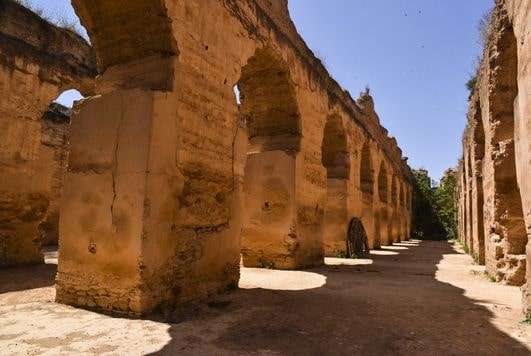
The terraces offer a fine view of the city. Dar el-Ma gives access to Heri es-Souani, the so-called Grainstore Stables, which are considered to be one of the sultan’s finest creations.
This monumental building, with 29 aisles, was designed for storing grain. The thick walls, as well as a network of underground passages, maintained the temperature inside the grainstore at a low and constant level. The ceilings collapsed during the earthquake of 1755.
Haras de Meknès
Zitoune Quarter of Meknès, southwest of the town. From Dar el-Ma, 1 km (0.6 mile) towards Dar el-Beida, turning right 400 m (440 yds) beyond Dar el-Beïda and continuing for 2 km (1 mile) to the south. Open 9amnoon, 2-6pm Mon-Fri.
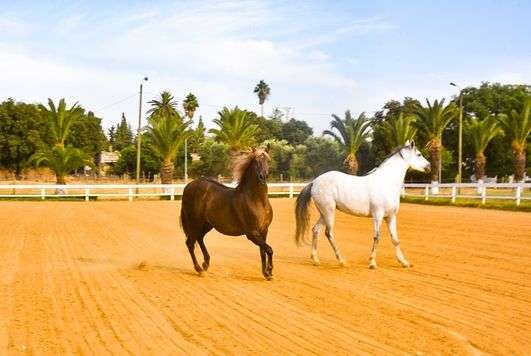
Although it cannot rival the modern studs in Rabat and Marrakech, the Haras de Meknès is well known in Morocco.
The stud was established in 1912 with the aim of improving blood lines and promoting various Moroccan breeds of horse for use in racing, competitive riding and fantasias.
The stud can accommodate 231 horses, ranging from purebred Arabs and Barbs to English thoroughbreds and AngloArabs. A visit here may include seeing horses being put through their paces.
Moulay Idriss
The most spectacular view of Moulay Idriss is from the scenic route from Volubilis to Nzala des Beni Ammar, which runs above the more frequently used road N13.
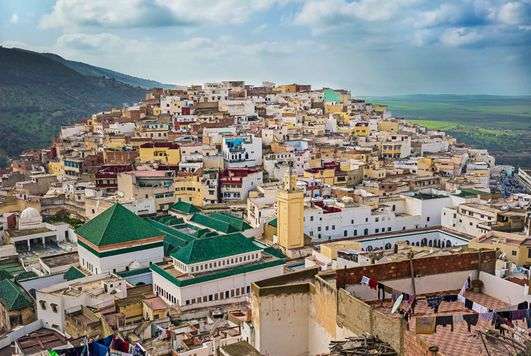
In a superb setting, the bright white town clings to two rocky outcrops between which rises the Tomb of Idriss I, conspicuous with its greentiled roof. Fleeing the persecution of the Abbassid caliphs of Baghdad, Idriss found a haven in Oualili (Volubilis).
A descendant of Ali, son-in-law of the Prophet Mohammed, he founded the first Arab-Muslim dynasty in Morocco. He died in 791 and was buried in the town that now bears his name.
It was not until the 16th century that the town began to prosper, and it was still in the process of developing in the 17th century, during the reign of moulay The latter endowed it with defensive walls and a monumental gate, as well as Koranic schools, fountains and a new dome for the mausoleum.
The Tomb of Idriss I is closed to non-Muslims, and a wooden beam across the entrance marks this as sacred ground, or horm. However, from the terrace, near the Mosque of Sidi Abdallah el-Hajjam, which perches above the town, there is a splendid view of the town and the mausoleum.
To the north is the Post Office (A. Laforgue, 1920), fronted by an open arcade decorated with zellij tilework and semicircular arches, which leads through to an Art Deco central hall within Opposite.
Zerhoun Massif
Zerhoun Massif About 50 km (31 miles ) northwest of Meknès. Culminating in Jbel Zerhoun, which rises to a height of 1,118 m (3,670 ft), the massif forms part of an extensive range of hills bordering the southern side of the Rif and running from the region of Meknès to the environs of Taza in the east.

This pre-Riffian terrain, consisting mostly of clay and marl, is very susceptible to fluvial erosion. As a result, a few outcrops of harder limestone and sandstone have emerged, one of which is Jbel Zerhoun, whose gorges, peaks and cliffs have all been created by erosion.
Water is abundant here, and the Romans tapped the springs to supply Volubilis. Large villages grew up on the hillsides, along the line of springs and at the foot of the massif. While fig trees, orange trees and olive trees grow on the higher slopes , corn and barley thrive in the valleys and on the lower hillsides.
Enclosures (zriba) made of loose stones or thorny branches, for small herds of cattle, sheep and goats, can be seen near the villages. For Moroccans, Zerhoun is a holy mountain, the home of many religious men, and the setting of numerous stories and legends.
Olive groves
Olive groves are a common sight around Meknès and Beni Mellal and in the Rif. The gnarled and knotty olive tree survives in poor soil, taking root in rough and uneven ground.
Olive oil is extracted by timehonoured methods. In the autumn, the green, black and violet-tinged olives are harvested, the mixture of all three determining the flavour and aroma of the oil. A heavy grindstone turned by donkeys grinds the olives, crushing both the flesh and the kernel.
The resulting dark-hued pulp is emptied into large, shallow, circular porous containers placed beneath the oil press. The oil seeps out and runs into vats, where, mixed with water, it floats to the surface, free of debris. A whole 5 kg (11 lb) of olives makes just 1 litre (1.76 pints) of oil.
On the colourful stalls in the souks, the different kinds of olives are piled up into pyramids; there are green olives with herbs, violet-hued olives with a sharp taste, piquant olives spiced with red peppers , olives with bitter orange, crushed black olives that have been sun-dried and steeped in oil, and olives for making tajine.

Exploring Volubilis
The ancient site of Volubilis was known from the 18th century, but it was not until the late 19th century that it was first investigated. Excavations resumed in 1915, and have continued almost uninterrupted since, although extensive areas still remain to be explored. Although Volubilis is not as large as some other Roman towns, it shows how thoroughly romanized Mauretania Tingitana had become.
This is seen in the public buildings and sophisticated town houses within the 2nd-century walls, which enclose an area of more than 400,000 sq m (4,300,000 sq ft).The site, a preexisting settlement on which the Romans imposed their way of life, features baths, oil presses, bakeries, aqueducts, drains and shops that evoke the inhabitants’ daily lives. Volubilis is well-signposted and easy to explore.
Volubilis The ancient town of Volubilis backs on to a triangular spur jutting out from the Zerhoun Massif. The site was settled and began to prosper under the Mauretanian kings, from the 3rd century BC to AD 40. Temples from this period, as well as a strange tumulus, have been uncovered. When Mauretania was annexed by the Roman emperor Claudius in AD 45, Volubilis was raised to the status of municipia (free town), becoming one of the most important cities in Tingitana.
The public buildings in the northeastern quarter date from the 1st century, and those around the forum from the 2nd century. After Rome withdrew from Mauretania in the 3rd century, the city declined. It was inhabited by Christians but had been Islamicized when Idriss I arrived in 788.
The House of Orpheus
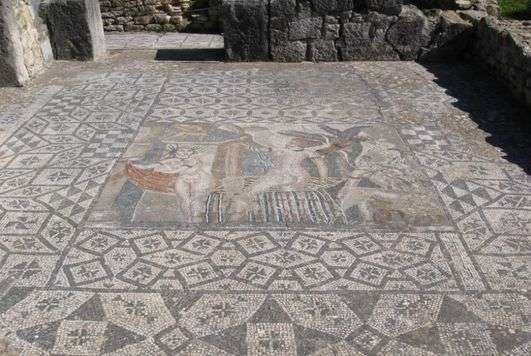
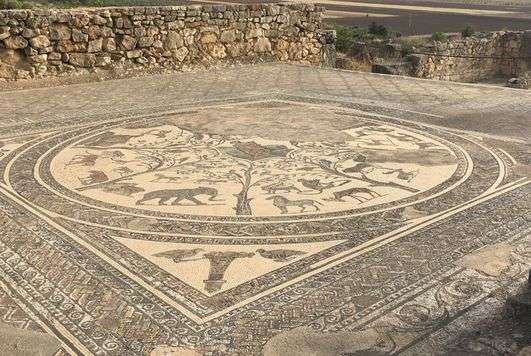
Located in the southern quarter of the city, the House of Orpheus is remarkable not only for its size but for the rooms that it contains. Opposite the entrance is a large peristyle courtyard, with a slightly sunken square pool that is decorated with a mosaic of tritons, cuttlefish, dolphins and other sea creatures.
The tablinum, looking onto the courtyard, is the main reception room; the centre is paved with the Orpheus Mosaic, the largest of the circular mosaics that have been discovered in Volubilis.
A richly dressed Orpheus is depicted charming a lion, an elephant and other animals with his lyre. The house also has an oil press with purification tanks, as well as private areas.
These have further rooms paved with mosaics in geometric patterns and bath suites with hypocausts (underfloor heating).
–
Oil Press
The reconstruction of an oil press near the House of Orpheus shows how this device worked in Roman times. The olives were crushed in a cylindrical vat by the action of a millstone fixed to a vertical axis.

The resulting pulp was emptied into rush or esparto baskets laid beneath planks of wood on which pressure was exerted by means of a beam that acted as a lever. The oil ran out along channels and into purification tanks set up outside.
Water poured into the tanks forced the better quality oil to float to the surface. It was then poured off into large earthenware jars for local use or for export.
The Forum, Basilica & Capitol
Like the other major public buildings in the heart of the city, the unusually small forum dates from the early 3rd century. It was the focal point of public life and administration, as well as a meeting place where business was done.
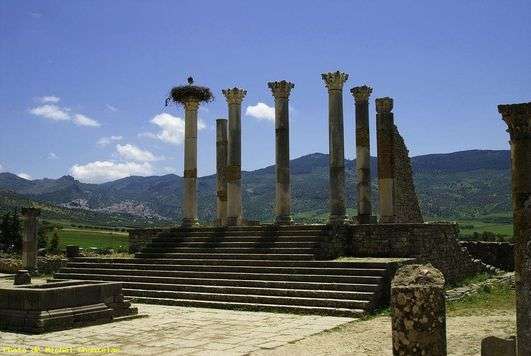
It is continued on its western side by the macellum, a market that was originally covered, On the left of the entrance, from the direction of the oil press, stands the stele of Marcus Valerius Servus, which lists the territory that the citizens of Volubilis possessed in the hinterland.
On the eastern side of the forum, a short flight of steps and three semicircular arches leads into the basilica. This was the meeting place of the curia (senate), as well as the commercial exchange and tribunal, and somewhere to take a stroll.
On the capitol, south of the basilica, public rites in honour of Jupiter, Juno and Minerva were performed.
House of the Athlete
The athlete that gives this house its name is the desultor, or chariot jumper, who took part in the Olympic Games. He would leap from his horse or his chariot in the middle of a race and remount or get back in immediately.
The mosaic here depicts the desultor as a parody. The naked athlete is shown bestriding a donkey backwards, and holding a cantharus, a drinking vessel given as a prize. The scarf, another emblem of victory, flutters in the background, behind the horseman.
House of the Dog & the Ephebe
The House of the Dog, behind the triumphal arch on the western side, is laid out to a typical Roman plan. A double doorway opens onto a lobby leading through to the atrium, This room, which is lined on three sides by a colonnade, contains a pool and leads in turn to a large dining room, or triclinium.

In 1916, a bronze statue of a dog was discovered in one of the rooms off the triclinium Opposite the House of the Dog stands the House of the Ephebe, where a beautiful statue of an ivy-wreathed ephebe (youth in military training) was found in 1932. It is now in the Musée Archéologique in Rabat.
Triumphal Arch & Decumanus Maximus
According to the inscription that it bears, the triumphal arch was erected in AD 217 by the governor Marcus Aurelius Sebastenus in honour of Caracalla and his mother Julia Domna. The statues that originally filled the niches in the arch were surmounted by busts of Caracalla and his mother within medallions.
Above the inscription, at the top of the monument, ran a frieze and a band, and the whole was crowned by a chariot drawn by six horses. The arch, which stands over 8 m (26 ft) high, was reconstructed in 1933. It faces west onto the plain and east onto the decumanus maximus.
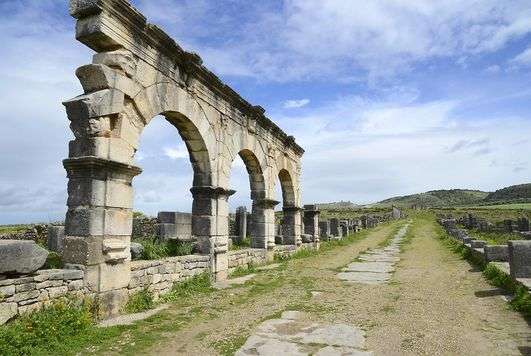
This main axis through the city, 400 m (1,312 ft) long and 12 m (39 ft) wide, leads from the triumphal arch in the southwest to the gateway known as Tangier Gate in the northeast
Parallel with the decumanus maximus, and a few metres away on its southern side, ran an aqueduct, substantial parts of which survive

This brought water from the Aïn Ferhana, a spring 1 km (0.6 mile) eastsoutheast of Volubilis, on Jbel Zerhoun, to the city’s baths and fountains. The largest of these fountains can be seen between the basilica and the triumphal arch.
Aristocratic Quarter
Fine houses, such as the elegant House of the Columns, House of the Knight and House of the Labours of Hercules, constituted the aristocratic quarter. The House of Dionysus and the Four Seasons, and the House of the Bathing Nymphs, have high quality mosaics.
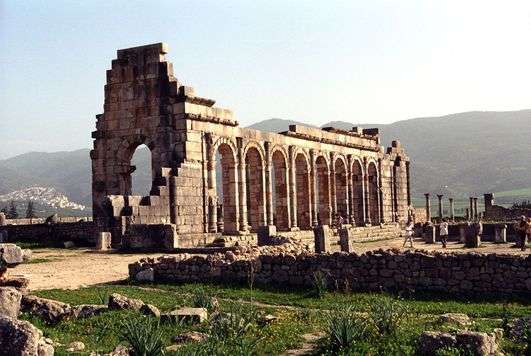
The Gordian Palace, named after Emperor Gordian III (238–44) and probably the residence of the Roman governor, is notable for the 12 columns that front it and the horseshoeshaped pool with almost perfectly semicircular outlines.
Venus Cortege
Busts of Cato the Younger and Juba Il were found south of the decumanus. The mosaic depicting the Cortège of Venus, which paved the triclinium, is displayed in the Musée Archéologique in Tangier. Some of the mosaics have motifs very similar to those seen in Berber carpets today.