FES
Located between the fertile lands of the Saïs and the forests of the Middle Atlas, Fès is the oldest of Morocco’s imperial cities. It is the embodiment of the country’s history and its spiritual and religious capital, and has been declared a World Heritage Site by UNESCO.
Morocco’s third-largest city, it consists of Fès el-Bali, the historic centre; Fès el-Jedid, the imperial city of the Merinids; and, located further south, the modern districts created under the Protectorate Idriss I founded Madinat Fas, on the right bank of the River Fès, in 789. In 808, his son, Idriss II, built another town on the left bank, which was known as El-Alya (High Town).
In 818, these two cities, each within their own walls, received hundreds of Muslim families who had been expelled from Córdoba. Soon afterwards, some 300 refugee families from Kairouan, in Tunisia, found asylum in El-Alya, which then became known as Karaouiyine, after them Within a few years, thanks to these two communities, the two towns became the centre of the Arabization and Islamization of Morocco In the mid-11th century, the Almoravids united the two towns, building a wall around them.
The Almohads took the city in 1145, after a long siege. Fès then became the country’s foremost cultural and economic metropolis, thanks in large part to the founding of its university. In 1250, the Merinids raised Fès to the status of imperial capital and endowed it with prestigious buildings.
To the west of the old town they established a new royal city, Fès el-Jedid (New Fès). Conquered by the Alaouites in 1666, Fès was spurned by Moulay Ismaïl, who chose Meknès as his capital. The city’s decline continued until the early 20th century.
When the Protectorate was established in 1912, a Ville Nouvelle (New Town) was built. After independence this was filled by the prosperous citizens of the old medina, while the country people, rootless and poon crowded into the old town of Fès el-Bali.
However, UNESCO’s ongoing restoration programme has saved the old city: Today, Fès is home to over a million people.
Exploring FES
Fès appears as a compact and tightly woven urban fabric. Enclosed within its defensive walls, Fès el-Bali, the historic medina, is a sea of rooftops from which emerge minarets and domes. Wadi Fès separates the two historic entities: the Andalusian Quarter to the east, and the Karaouiyine Quarter to the west.
Fès el-Jedid is built on a height south of the medina. Notable features here include the royal palace and the former Jewish quarter.
The Ville Nouvelle (New Town), dating from the Protectorate, lies further south.
Merinid Tombs
North of the medina, on the hill of the Merinid tombs. Standing among olive trees, cacti and blue agaves, the 16th-century ruins that overlook Fès el-Bali are those of a Merinid palace and necropolis.
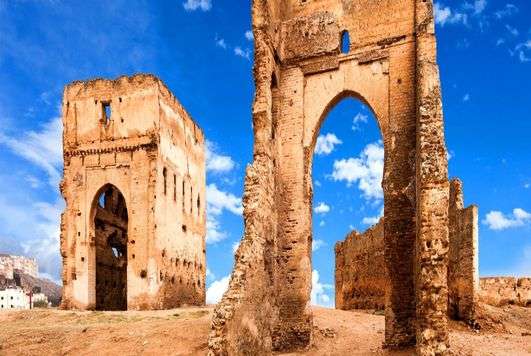
Ancient chroniclers recorded that these tombs elicited wonderment because of their magnificent marble and the splendour of their coloured epitaphs. Today, the tombs are very dilapidated, and the area is popular with petty thieves, but it offers an impressive view of the city and is well worth the climb.
The stretch of wall immediately beneath the hill is the oldest part of the medina’s defences.
Parts of the curtain wall date from the Almohad period (12th century), notably Borj Kaoukeb, near which the lepers’ quarter was once located The tombs overlook a tiered cemetery which stretches as far as Bab Guissa, an Almohad gateway dating from the 13th century.
Borj Nord
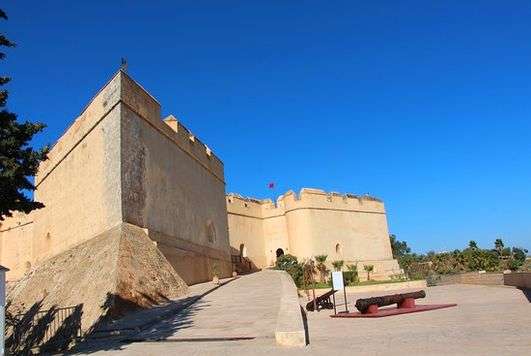
Open 9am-4:30pm Tue-Sun. Borj Nord was built in 1582, on the orders of the Saadian sultan Ahmed el-Mansour (1578–1603).
From its vantage point over the city, the fortress both defended and controlled Fès el-Bali. In 1963 the collection of weapons from the Musée Dar el-Batha was transferred here to create the Museum of Arms.
Much of the coliection, comprising more than 8,000 pieces, comes from the Makina, the arsenal built by Moulay Hassan I at the end of the 19th century, although it was enriched by donations from various Alaouite sultans. Some 1,000 pieces of weaponry are exhibited in 16 rooms, in a chronological display running from prehistory to the first half of the 20th century.
Moroccan weapons are well represented and demonstrate the technical knowledge of Moroccan craftsmen. There is also an interesting collection of weapons from all over the world.
Bab Boujeloud
Place du Pacha el Baghdadi. Enclosed within high walls, the large Place Pacha el-Baghdadi links the medina and Fès el-Jedid. On one side of the square stands Bab Boujeloud.
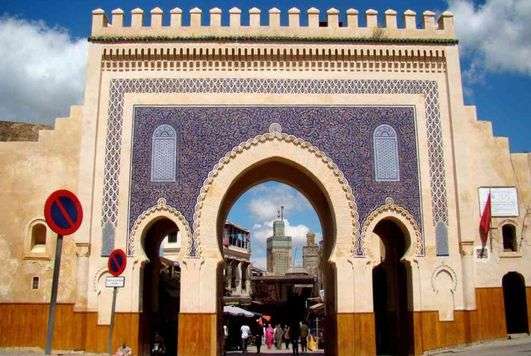
Built in 1913, this fine monumental gate is the principal entrance into Fès el-Bali With the development of heavy artillery, the fortified gates of Fès lost their effectiveness as defences and came to be seen as decorative buildings, contributing to the city’s prestige and helping to justify the levy of city taxes.
Bab Boujeloud, built in the Moorish style, consists of three perfectly symmetrical horseshoe arches. A rich decorative scheme consisting of geometric patterns, calligraphy, interlaced floral motifs and glazed tilework of many colours, with blue predominating, graces the facade.
From this entranceway the silhouette of the minaret of the Bou Inania Medersa can be glimpsed on the left.
Talaa Kebira
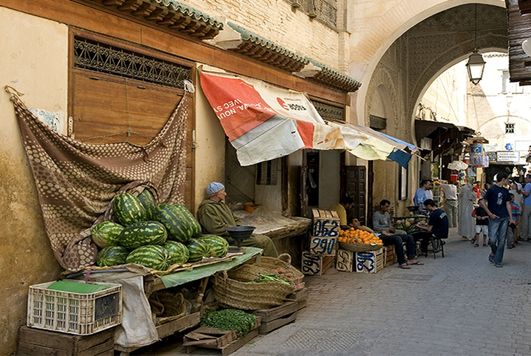
Rue Talaa Kebira Reached via Bab Boujeloud. This thoroughfare, whose name means “Great Climb” and which is partly covered by a cane canopy, is lined with small shops along almost its entire length. It is continued by the Ras Tiyalin and Aïn Allou souks and by spice markets.
The street passes the kissaria and ends at the Karaouiyine Mosque . Running parallel to it at its southern end is another important street, Rue Talaa Seghira (“Short Climb”), which joins up with Rue Talaa Kebira at Ain Allou. These streets are the two principal cultural and economic thoroughfares of Fès el-Bali.
The city’s most important buildings are located here. Opposite the Bou Inania Medersa stands Dar el-Magana (House of the Clock), built by the ruler Abou Inan in 1357. It contains a water-clock built by Fassi craftsmen during 10 the Merinid period.
Not far from here, level with a covered passage in the Blida Quarter, is the Zaouia el-Tijaniya, containing the tomb of Ahmed el-Tijani, master of Tariga el-Tijaniya (The Way), a doctrine that spread widely throughout the Maghreb and sub-Saharan Africa.
Further on are three musical instrument workshops. Makers of stringed instruments have almost completely disappeared from Fès; the only remaining practitioner is a craftsman in Rue Talaa Seghira, opposite Dar Mnebhi, who still makes ouds (lutes) by traditional methods.
Beyond is the skindressers ‘ fondouk, which contains leather workshops Across the Bou Rous bridge stands the Ech Cherabliyine Mosque (Mosque of the Slipper-Makers). Built by the Merinid sultan Abou el-Hassan, it is distinguished by its elegant minaret.
The Souks
The souks of Fès el-Bali spread out beyond the Ech Cherabliyine Mosque. The location of each souk reflects a hierarchy dictated by the value placed on the various goods on offer in each of them.
Makers and sellers are grouped | together according to the products that they offer. Every type of craft has its own street, or part of a street, around the Karaouiyine Mosque, which has resulted in a logical but relatively complex layout.
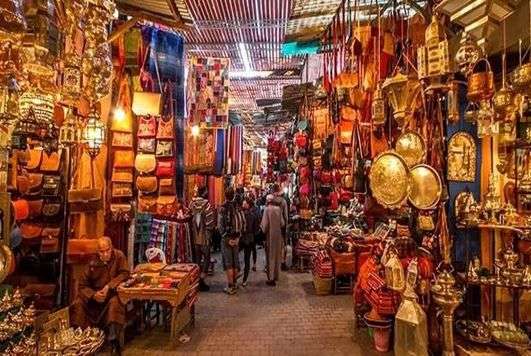
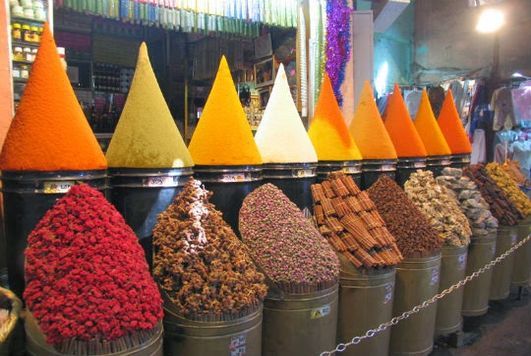
While the El-Attarine Souk sells spices, there is also a Slipper Souk and a Henna Souk, which is laid out in an attractive shaded square planted with arbuses.
A plaque records that the Sidi Frijthe maristan, which was the largest mental asylum in the Merinid empire, once stood on this square.
Built by Abou Yacoub Youssef (1286 1307), it also functioned as a hospital for storks. It was still in existence in 1944.
In the 16th century, Leo Africanus, known today for his accounts of his travels, worked there as a clerk for two years The kissaria, near the Zaouia of Moulay Idriss, marks the exact centre of the souks.
This is a gridwork of covered streets where shops selling luxury goods are especially conspicuous. Some of the fine silks and brocades, high-quality kaftans and jewellery on offer here supply the international market.
El-Nejjarine
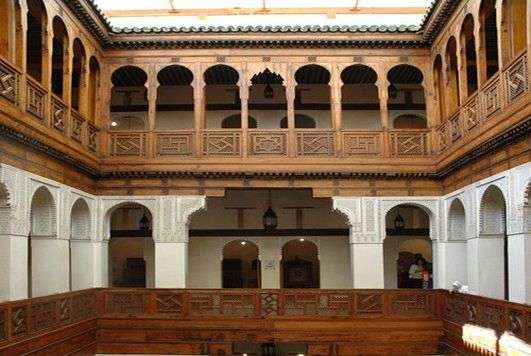
Place el-Nejjarine. Musée du Bois: Open 9am-6pm daily. Not far from the Henna Souk, the impressive Fondouk el-Nejjarine, with an elegant fountain, is one of the most renowned buildings in Fès.
Built by the amine (provost) Adeyel in the 18th century, this former caravanserai provided food, rest and shelter to the traders in luxury goods arriving from the interior. Classed as a historic monument in 1916, it is now one of UNESCO’s World Heritage Sites.
Its restoration formed part of the preservation programme carried out on the whole medina.
The fondouk’s three floors house the privately run Musée du Bois (Museum of Wooden Arts). The displays include carved doors from the Magnificent Bounania Medersa.
Dar El-Batha Museum
The palace of Dar el-Batha was begun between 1873 and 1875 by Moulay el-Hassan, and was completed by Moulay Abdel Aziz in 1897. The location of the palace was an area of neglected gardens, which had been irrigated by a river.

The sultan, who wanted to make the palace a residence worthy of being used for official receptions, added an imposing courtyard covered with coloured tiles and featuring a large fountain. He also laid out a large and very fine Andalusian garden. Despite many later alterations, the traditional Moorish features of this building have survived.
El-Attarine
Miedersa Opposite the ka souvine Mosque. 9am-6pm daily. Closed Fri. je The El-Attarine Medersa (Medersa of the Spice Sellers) stands in the neighbourhood of the Karaouiyine Mosque and the El-Attarine Souk.
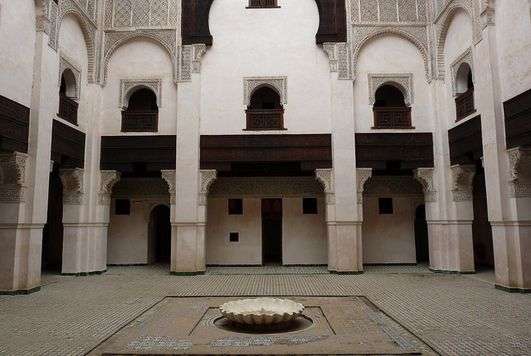
The highly decorated entrance leads through to a courtyard paved with zellij tilework in a two-colour pattern of brown and white, and enclosing an ablutions fountain A cladding of polychrome tiles covers the base of the courtyard’s four interior walls and its columns.
A door with fine decoration and exquisite fittings leads from the courtyard to the prayer hall, which contains a mihrab.
Built by Abou Yacoub Youssef (1286 1307), it also functioned as a hospital for storks. It was still in existence in 1944.
El-Cherratine
Located southeast of the Karaouiyine Mosque, in Rue el-Cherratine (Street of the Ropemakers), this medersa was built by Moulay Rachid, the first Alaouite sultan, in 1670.
Although it is structurally simili to the Merinid medersas, it is elaborately decorated. Addine to the building’s austerity are ne high, narrow residential units known as douiras, which stand in three corners of the courtyard.
The tiny cells inside were for the use of students. Entry into the medersa is through beautiful double doors cased in engraved bronze.
The doors open onto a passageway with a fine carved and painted wooden ceiling, which in turn leads to the Moorish courtyard.
Bou Inania Medersa
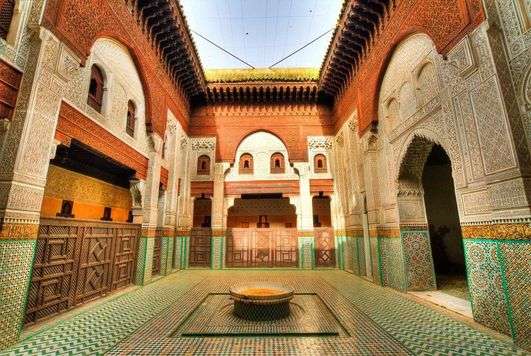
This is the largest and most sumptuously decorated medersa ever built by the Merinids. Constructed between 1350 and 1355 by the sultan Abou Inan, it is the only medersa in Morocco that has a minbar (pulpit) and a minaret.
A mosque, cathedral, students’ residence and school combined its functions have determined its architectural complexity. The one-storey building, on a rectangular plan, is arranged around a square Moorish courtyard paved with marble and onyx, and surrounded on three sides by a cloister. It is one of the few Islamic religious buildings that is open to non-Muslims.
Capitals
The carved motifs on the capitals in the medersa show Moorish influence.
Prayer Hall
The mihrab (above) is surmounted by stained-glass windows. The minbar (1350) is now in the Musée Dar el-Batha.
Façade
Richly decorated with zellij tilework, stuccowork and sculpted wood, the façade runs the gamut of the Moorish decorative repertoire.
Stained-glass
Windows The windows of the prayer hall feature old stained glass panels.
Windows
The ornate windows of the students’ rooms on the upper floor are framed by stuccowork surmounted by muqarnas .
Wooden Screen
The magnificent carved wooden screen of the main entrance is framed by sturdy pillars The adjoining door of much planet design was known as Beggars Gate.
Zellij Tilework
In the medersa, the three decorative bands always appear in the same order: geometric tilework below, cursive script carved into tiles in the centre, and stuccowork above.
Moroccan Medersa
The medersa was both a cultural and a religious establishment.
It was primarily a residential college, designed for local students from the town or city and especially for those from the immediate or more distant rural areas, but also Student at a medersa for anyone who came in search of learning. It was an extension of the great university-mosque, an institution once restricted to the study of religion, law, science and even the arts. It was finally a place of prayer and reflection. The medersas of Fès, home to the greatest scholars in the country, were the most highly esteemed in Morocco.
The Tanneries
Often located near watercourses, and usually some distance from residential quarters thousands of years. The process turns animal hides into soft, rot-proof leather. Once contribution to a city’s economy. Tanning is a craft with traditions that go back tanned, the hides are passed on to leatherworkers.
Tanners’ Quarter North of Place el-Seffarine. The Chouara, has been located near Wadi Fès since the Middle Ages. Its dyeing vats, in the midst of houses in the Blida quarter, are best seen from neighbouring terraces. Although pervaded by an unpleasantly strong smell, this is the most lively and picturesque of all the souks in Fès.
Stages in the Tanning
Process In Fès, the tanneries (chouaras) are located near Wadi Fès. The hides of sheep, goats, cows and camels undergo several processes – including the removal of hair and flesh, followed by soaking in vats, then by drying and rinsing – before they are ready to be dyed and handed over to leatherworkers.
Vats
some of which have been in use for centuries, are used for soaking skins after the hair and flesh have been removed. The tanning solution that turns them into leather is obtained from the bark of pomegranate or mimosa.
The dried hides
are rinsed in generous quantities of water. They are then softened by being steeped in baths of fatty solutions.

The tanned hides
are hung out to dry on the terraces of the medina, as here, or in other parts of Fès, such as the Bab el-Guissa cemetery. The roofs of houses and the hillsides around the city may also be used as drying areas.
Natural pigments
Obtained from certain plants and minerals, are still used by Moroccan craftsmen to colour the hides. However, chemical dyes are also used today.
Dyed leather
is used to make many types of useful and decorative objects, such as embroidered bags, babouches, pouffes and clothing. These goods are offered for sale in the numerous souks in the medina of Fès.
El-Seffarine
Place el-Seffarine fès is the most important centre for the production of brass and silverware in Morocco. The workshops of brass-workers and coppersmiths lining Place el-Seffarine have been here for centuries.

The pretty fountain with fleur-de-lis decoration is worth a look. It was probably built by French convicts in the 16th century. North of the square is the 14th-century Karaouiyine Library, which was set up on the orders of the sultan Abou Inan.
It was used by the greatest Moorish men of learning, including the philosopher and doctor Ibn Rushd, known as Averroës, the philosopher Ibn Tufayl, the historian Ibn Khaldoun and the 6th-century traveller Leo Africanus.
The manuscripts that once formed part of the library’s collection have been transferred to the Royal Library in Rabat The El-Seffarine Medersa opposite the Karaouiyine Library, was built in 1280 and is the oldest medersa in Morocco that is still in use.
The ElMesbahiya Medersa, also north of the square, was built by the Merinid sultan Abou el Hassan in 1346. Further on, on the right, is the 16th-century Tetouani Fondouk, which accommodated traders and students from Tetouan.
Place el-Seffarine leads to Rue des Teinturiers (Dyers’ Street), which runs parallel to the wadi and is where skeins are hung out to dry.
Andalusian Mosque
Accessible via Rue el-Nekhaline or Bab el-Ftouh and Rue Sidi Bou Ghaleb Closed to non-Muslims. According to legend, this mosque was established by a religious woman, Mariam el-Fihri, sister of the founder of the Karaouiyine Mosque, and by the Andalusians who lived in the Karaouiyine Quarter.
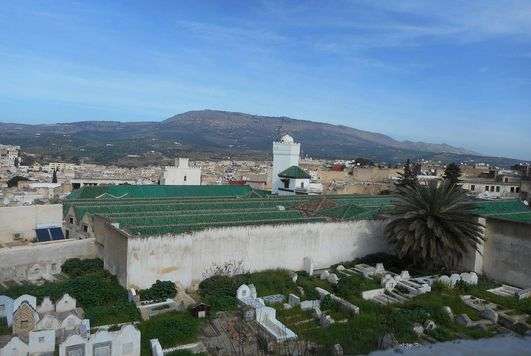
Its present appearance dates from the reign of the Almohad ruler Mohammed el-Nasser (13th century). The Merinids added a fountain in 1306 and funded th establishment of a library here in 1416. Non-Muslims can only admire the building from the exterior; notable are the great north entrance, with a carved cedar awning, and the domed Zenet minaret.
Andalusian Quarter
The Andalusian Quarter did not undergo the same development as the Karaouiyine Quarter, located on the opposite bank of Wadi Fès and better provided with water. Nevertheless, this part of the city, which is quieter and more residential, has monuments that are worth a visit.
The El-Sahrij Medersa, built in 1321 takes its name from the large water basin in one of the courtyards. This is considered to be the third-finest medersa in Fès after the Bou Inania and the El-Attarine medersas. The Mausoleum of Sidi Bou Ghaleb, in the street of that name, is that of a holy man from Andalusia who lived and taught in Fès in the 12th century.
Bab el-Ftouh
Bab el-Ftouh Southeast of the medina. Literally meaning “Gate of the Aperture”, the huge Bab el-Ftouh is also known as the Gate of Victory. It leads through to the Andalusian Quarter.
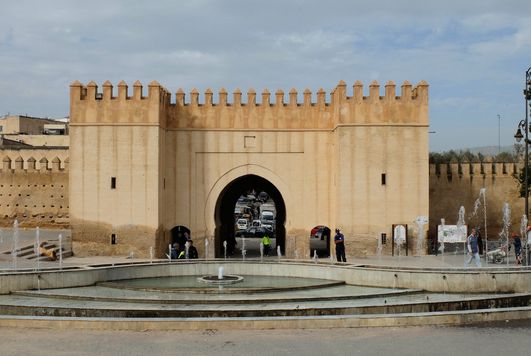
The gate was built in the 10th century by a Zenet emir, and was altered in the 18th century, during the reign of the Alaouite ruler Sidi Mohammed ben Abdallah. Outside the ramparts, on a hill opposite the city, is the Bab el-Ftouh cemetery, where some of the most illustrious inhabitants of Fès are buried.
Karaouiyine Mosque
Established in 859, the Karaouiyine Mosque is one of the oldest and most illustrious mosques in the western Muslim world. The first university to be established in Morocco, it was frequented by such learned men as Ibn Khaldoun , Ibn el-Khatib, Averroës and even Pope Sylvester II (909–1003).
Named after the quarter in which it was built – that of refugees from Kairouan, in Tunisia – it was founded by Fatima bint Mohammed el-Fihri, a religious woman from Kairouan, who donated her worldly riches for its construction. It is still considered to be one of the main spiritual and intellectual centres of Islam and remains the seat of the Muslim university of Fès.
Dome Over the Entrance
The main entrance into the courtyard of the mosque faces Rue Bou Touil. The monumental doorway is surmounted b a small striated dome.
Pitched Roof
The roof of the mosque is covered in emerald-green tiles.
Ablutions Basin
Its in the centre of the courtyard, is carved from a single block of marble. It rests on a marble fountain to which the faithful come to carry out their ablutions, an essential preparation for prayer.
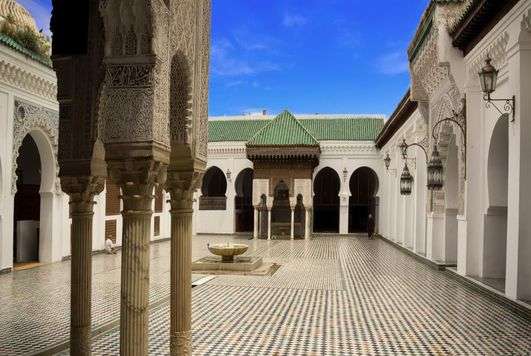
The Prayer Hall
The hall is divided into 16 aisles by 270 columns, parallel to the qibla wall . It is lit by a magnificent 12th-century Almohad candelabra.
The Courtyard
Or sahn, is paved with zellij tilework consisting of 50,000 pieces that were made especially for the floor of the mosque.
Mashrabiyya
The main doorway has a mashrabiyya screen to protect worshippers from prying eyes.
The Role of the Mosque
Each quarter of Fes has one or more mosques and other places of Worship, Friday prayers take place in both large and small mosques. Msids, small oratories without a minaret, are designed for prayer and for teaching the Koran.
Zaouias are sanctuaries where religious brotherhoods gather. The mosque, which stands both as a civic and a social symbol, is simultaneously a place of worship, a university, a tribunal, an inviolable place of asylum and a friendly meeting place. The call to prayer is given by the muezzin five times a day.
Fès El-Jedid
Fès el-Jedid, meaning New Fès or White Fès, was built in 1276 by Merinid princes as a stronghold against the permanent threat of the rebellious Fassis, and as a vantage point from which to survey their activities in the old town.
Surrounded by ramparts, Fès el-Jedid was primarily a kasbah, and its political and military role predominated over the civic functions of a true Islamic town.
It was the administrative centre of Morocco up to 1912. Fès el-Jedid consists of several distinct units. In the west is the royal palace, and other buildings associated with it, and the Moulay Abdallah Quarter.
In the south is the mellah, or Jewish quarter, a maze of dark, narrow streets. In the east are the Muslim quarters.
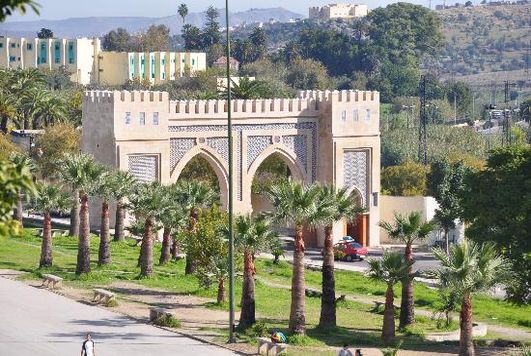
Dar el-Makhzen
Dar el-Makhzen Closed to the public. This palatial complex in the centre of Fès el-Jedid is surrounded by high walls and covers more than 80 ha (195 acres). It was the main residence of the sultan, together with his guard and his retinue of servants. It was also where dignitaries of the makhzen (central government) came to carry out their duties.

Part of the palace is still used by the king of Morocco when he comes to stay in Fès. The main entrance to the complex, on the huge Place des Alaouites, is particularly imposing.
Its magnificent Moorish gateway, which is permanently closed, is richly ornamented. The exquisitely engraved bronze doors are fitted with fine bronze knockers.
The walls enclose a disparate ensemble of buildings: palaces arranged around courtyards or large patios, as well as official buildings, notably the Dar el-Bahia, where Arab summit meetings are held; the Dar Ayad el-Kebira, built in the 18th century by Sidi Mohammed ben Abdallah; administrative and military buildings; and gardens, including the enclosed Lalla Mina Gardens.
The complex also includes a mosque and a medersa, which was built in 1320 by the Merinid prince Abou Saïd Othman. There is also a menagerie.
Mellah
Accessible via Place des Alaouites or Bab el Mellah Bab el-Semarine, then Bab el-Mellah leads into the mellah, the Jewish quarter of Fès. The name mellah probably comes from the Arabic word for “salt”, the terrain on which the quarter grew.
This quarter, thought to be the first Jewish enclave to be established in Morocco, was originally located in the northern part of Fès el-Bali, in the El-Yahoudi Quarter next to the Karaouiyine district.
In the early 13th century the Merinid rulers moved it near the palace, to the site of a former kasbah that was once occupied by the sultan’s Syrian archers. The rulers of Fès had undertaken to protect the Jewish community, in return for an annual levy collected by the state treasury.
The Jewish quarter’s new location afforded the inhabitants greater security, With its souks, workshops, schools, synagogues and a cemetery, the quarter flourished, providing the Jewish community with strong social cohesion and unrivalled opportunities for social advancement.
Like the Muslims elsewhere, most of the Jews in the district were grouped according to their craft speciality. Thus Leo Africanus mentioned metalworking, recording that only the Jews worked with gold and silver.

Today, the Jews of Fès have left to settle in Casablanca or have emigrated abroad, to Israel in particular. Exploring the mellah reveals a striking contrast with the Muslim quarters. In architectural terms it is another world, the buildings being higher, narrower and more closely spaced.
The present boundaries of the Jewish quarter were established only at the end of the 18th century, during the time of the Alaouite sultan Moulay Yazid, and the space available was small. As a result, the inhabitants were forced to build two-storey houses around tiny courtyards, and space to move around in was very restricted.
Danan Synagogue
Der el-Feran Teati street. Open 9am5pm daily. No entrance fee but a small contribution is requested. Jewish Cemetery: Closed Sat.
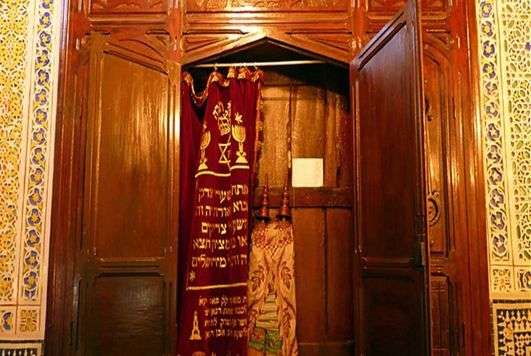
The 17th-century synagogue, the property of a family of rabbis from Andalusia, looks as if it has been squeezed in between the houses in the mellah. The interior is divided into four aisles.
A trap door in the aisle on the far right opens onto a stairway that leads down to a mikve – a bath for ritual purification where the faithful were cleansed of their sins. Above this fourth aisle is the azara, the women’s gallery, which offers an overall view of the synagogue.
It is worth going out onto the terrace for a sweeping view of the mellah, and of the white tombs of the Jewish cemetery below.