ESSAOUIRA
With the brilliant whiteness of its lime washed walls and the sight of women enveloped in voluminous haiks, Essaouira, formerly Mogador, is a quintessentially Moroccan town and one of the most enchanting places in the country.
By virtue of its location on this stretch of the Atlantic coast, where trade winds prevail almost all year-round, the town enjoys a particularly pleasant climate. It is a prime location for surfing, but has managed to escape mass tourism.
A mecca for hippies during the 1970s, it is still an artists’ town and is very fashionable with independent travellers.
Exploring Essaouira
In the 7th century BC, the Phoenicians founded a base on the site where Essaouira now stands, and in the 1st century BC Juba Il made it a centre of the manufacture of purple dye. The Portuguese established a trading and military bridgehead here in the 15th century, and named it Mogador. The town itself, however, was not built until around 1760, by the Alaouite sultan Sidi Mohammed ben Abdallah (Mohammed III), who had decided to set up a naval base here. The town, the harbour and the fortifications, in the style of European fortresses, were designed and built by Théodore Cornut, a renowned French architect who had worked for Louis XV.
Ramparts
On the side facing the sea, the outer walls, which have bevelled crenellations, were designed to give protection from naval attack and are thus typical of European fortifications. By contrast, the inner walls, which have square crenellations and are similar to the fortifications around Marrakech, are Islamic in style.
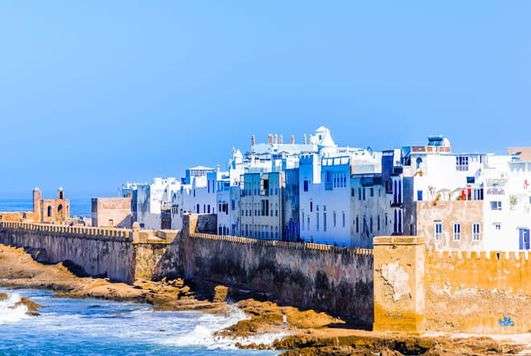
These are built in stone and roughcast with a facing of earth. The walls are pierced by gates – Bab Sebaa on the southern side, Bab Marrakech on the eastern side and Bab characteristic haik Doukkala on the northeastern side – that lead into the medina.
Sqalas
Two sqalas (sea bastions) were built to protect the town: the Sqala de la Ville, in the northwest and the Sqala du Port, in the south, The Sqala de la Ville consists of a crenellated platform featuring a row of Spanish cannons and defended at its northern end by the North Bastion.
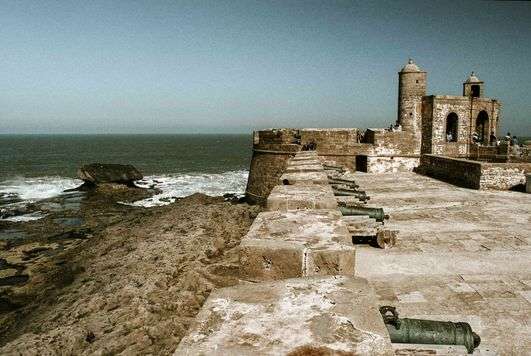
This was built by Théodore Cornut on the site of the Castello Real, a citadel constructed by the Portuguese in about 1505. The esplanade (where scenes from Orson Welles’ film Othello were shot in 1949) commands a view of the ocean and the lles Purpuraires. A covered passage leads from the bastion to the former munitions stores, which now house marquetry workshops.
Port
Sqala du Port. Open daily. The Porte de la Marine, leading to the docks, is crowned by a classical triangular pediment and dominated by two imposing towers flanked by four turrets.
The rectangular Sqala du Port is surmounted by battlements. From the 18th century, 40 per cent of Atlantic sea traffic passed through Essaouira.
It became known as the Port of Timbuctu, being the destination of caravans from sub-Saharan Africa bringing goods for export to Europe. Once one of Morocco’s largest sardine ports Essaouira now provides a living for no more than 500 to 600 families.
But it still has its traditional shipyard, where vessels are made out of wood, Visitors can also watch the fish auction and sample freshly grilled sardines

Medina
The layout of Essaouira is unusual because it was planned before the town was developed.
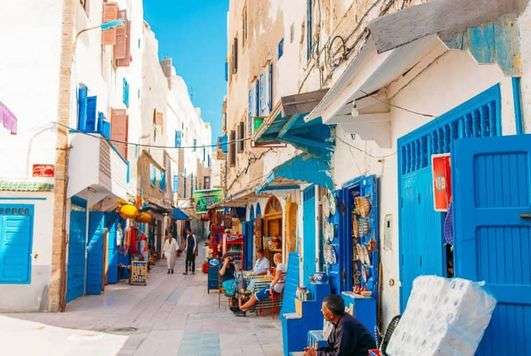
It was laid out by the French architect Comut, who, between 1760 and 1764, built the Sqala de la Ville and the Sqala du Port, endowing them with fortifications and outer and inner walls.
As elsewhere in Morocco, the medina in Essaouira is a labyrinth of narrow streets; the town itsell, by contrast, has straight, wide streets laid out at right angles to one another and cut by gateways,
The Grand Mosque situated in the heart of the medina, Further north, the market, Souk Jdid, is divided into four by the intersection of two thoroughfares, there is a daily souk for fish, spices and grains, and a souk for secondhand and collectable items, known as joutla,
Working with Thuya
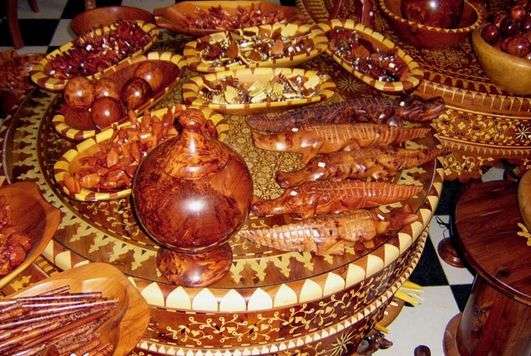
Thuya , a highly prized wood with a delicious perfume, grows abundantly in the region of Agadir and Essaouira, and has been the source of that latter’s prosperity. Thuya is a very dense hardwood, and almost every part of the tree apart from the branches can be used the trunk, with its relatively light-coloured wood; the stump, used for making small objects; and the gnarl, a rare excrescence streaked with brown and pink.
The gnarl is polished, inlaid with decorative motifs in citron wood, mother-of-pearl or ebony and sometimes with threads of silver or copper, or slivers of camel bone. It is used to make such items as coffee tables, caskets, small statues, boxes in all shapes and sizes, trays and jewellery. The country’s best marquetry craftsmen can be seen working at this traditional craft in the former munitions stores beneath Essaouira’s ramparts.
The High Sheen
Of this bread box is produced by polishing the surface with methylated spirit and gum arabic. Linseed oil feeds the wood and prevents it from developing cracks.
Artisans
apply all their ingenuity and imagination to produce novel shapes.
The Thuya Gnarl
This excrescence, which grows on certain trees, particularly the thuya, is highly sought after by cabinet-makers for its veined and speckled appearance.
The Decoration
Of this dish is based on a geometric scheme. The border pattern consists of an inlay of alternating pieces of ebony and citron wood.
Former Mellah
From Bab Doukkala, accessible via Rue Mohammed Zerktouni. Controlled access. Having risen to prominence and prosperity in the 18th and 19th centuries, the Jewish community in Essaouira came to hold an important economic position in the town, and Jewish jewellers acquired wide renown.
The town’s former Jewish quarter is no longer inhabited by Jews, but on Rue Darb Laalouj the former houses of Jewish businessmen can still be seen; they are now converted into shops.
In contrast to Muslim houses, they are fronted by balconies opening onto the street and some have lintels with inscriptions in Hebrew. Rue Mohammed Zerktouni, the main street in the quarter, has a very lively market.
Leaving by Bab Doukkala, you will pass the austere Jewish cemetery, which is worth a visit. (The keys are available on request from the caretaker).

Notre-Dame Church
Avenue El-Moukaouama, south of the post office t 9am Mon-Sat, 10am Sun. This Catholic church stands outside the walls of the medina, on the road leading to the beach.
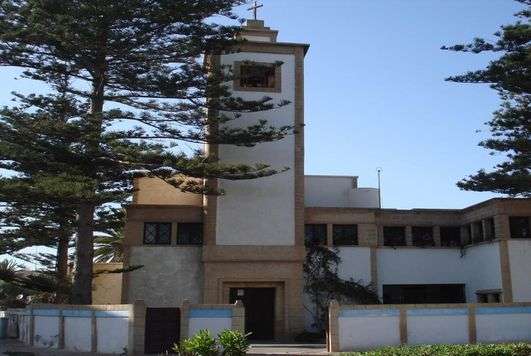
It is the only church in the country where the bells are rung on Sundays to summon the faithful to mass at 11am Most of the church furnishings are made of thuya wood. On an alternating basis, the services here are said in one of four languages: French, English, Dutch or German.
Beach
Essaouira’s beach, to the south of the town centre, is known as one of the finest in Morocco. All through the summer, the trade winds keep this part of the coast surprisingly cool. At times, however, the gusty winds are so strong that they drive people to seek shelter in the medina.
At the estuary of Wadi Osob, on the far side of the beach, vestiges of the system of defences built on a rocky promontory by the sultan Sidi Mohammed are visible. Although they have crumbled, thick walls can still be made out By following the wadi upstream, after a tumbleddown bridge, you reach the village of Diabet.
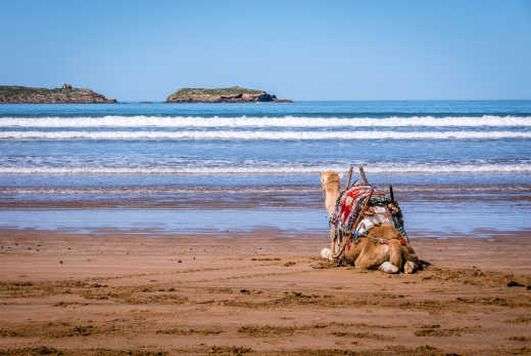
It is also accessible via the road to Agadir, turning off to the right after 7 km (4 miles). An interesting sight here are the ruins of Dar Soltane Mahdounia, a palace built by Sidi Mohammed ben Abdallah in the 18th century and now almost completely engulfed in sand.
It inspired Jimi Hendrix (who lived in Diabet for several years) to write the song Castles in the Sand.
Surfers will particularly enjoy the many beaches each side of Essaouira. Thanks to the enterprise of dynamic local associations, Morocco is about to become one of the top destinations for surfers and windsurfers. (The Océan Vagabond café is a good place to hire surfing equipment).
The windiest time of year in the Essaouira area, and therefore the best time for surfing and windsurfing here, is from April to September. However, while the air, at 20 30 °C (68-86°F). is always pleasantly warm the water is always a very cool 16-18°C (61-64 °F) South of Essaouira, at Cap Sim (beyond Diabet) and at Sidi Kaouki, and to the north, at Moulay Bouzerktoun, the waves are very strong, and safe only for experienced surfers.
Also to the south, at Tafelney (beyond the village of Smimou), there is a magnificent bay where the water is warmer. In spite of the constant gusty wind, it is easier to get into the water on the beach at Essaouira, as the waves are much gentler.
Essaouira Painters
Essaouira, a town imbued with art and culture, is home to a group of painters known as “free artists”, each of whom has his or her own unique style. Their talents have won recognition abroad and their work has been shown in many European art galleries. Using bright colours, their naive or “tribal” art is inspired by the myths, Arab-Berber history and African origins of Moroccan popular culture. These self-taught painters are also woodcarvers, sailors and builders, and they have in common an unconditional love of their town. Arabesques, geometric designs, dots, stippling and a swarm of objects, animals and human figures populate their poetic world.
Abdallah Elatrach
Is inspired by scenes of daily life in the souks and by the traditions of various brotherhoods whose rituals involve trance.
Ali Maïmoune
Paints tree-filled worlds that are populated by terrifying monsters, animals and fantastic warriors.

Mohammed Tabal
A leading figure in Essaouira’s artistic circles, Mohammed Tabal draws inspiration from his Gnaoui ancestry – from the ritual of spiritual possession and from the trances that form part of the rites of this popular brotherhood of African origin His paintings are splashed with bright, contrasting colours and feature a multitude of tiny details, such as naive motifs rich in symbolism.
Safi
An portant Moroccan por since the 16th century, the town of Safi is today an industrial centre and a major sardine processing port. It owes its importance to the growth of the fishing industry and to the processing and export of phosphates, as well as to its pottery. A rapidly expanding town, Safi has an interesting medina as well as traces of its Portuguese history.
Medina
The area covered by the medina takes the form of a triangle whose widest side faces onto the coast. Rue du Souk, lined with shops and workshops, leads to Bab Chaaba (Gate of the Valley). Near the Grand Mosque, south of the medina, is the Portuguese Chapel, originally the choir of Safi’s cathedral , built by the Portuguese in 1519.
Dar el-Bahr
This small fortress, also known as the Château de la Mer, overlooks the sea. It was built by the Portuguese at the beginning of the 16th century, and served as a residence for the governor, then for the sultans in the 17th century. On the esplanade are cannons cast in Spain, Portugal and Holland.
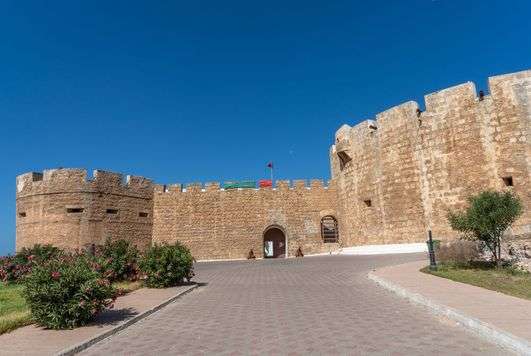
National Museum of Ceramics
Built by the Portuguese in the 16th century, the citadel, known as the Kechla, encloses a mosque and garden dating from the 18th and 19th centuries. Since 1990 the Kechla has housed the Musée National de la Céramique, which contains displays of traditional and modern ceramics, including blue-on-white wares made in Safi, pottery from Fès and Meknès, and pieces by Boujmaa Lamali (1890–1971).
Colline des Potiers
In the Bab Chaaba district, craftsmen can be seen making the ceramic wares that have made Safi famous. Finished pieces are displayed and offered for sale in commercial showrooms and visitors can follow the various stages of pottery production school.
Morocco Sea Fishing
The Moroccan coastline, which is more than 3,500 km (2,175 miles) long, faces both the Atlantic Ocean and the Mediterranean Sea, and gives the country access to some of the richest fishing grounds in the world – with some 240 species of fish. Morocco brings in the largest catches of fish in the whole of Africa. Its pre-eminence is due especially to sardines, of which Morocco is the largest processor and exporter in the world Coastal fishing has created a major canning industry, too. The Moroccan sea fishing industry employs some 200,000 people and exports bring in US $600 million per year. Modern fishing methods, however, have not completely replaced traditional ways.
Sardine fishing
In Essaouira uses swivel nets. In spite of their expert knowledge of the sea bed, the fishermen often have to repair damaged nets when they return to harbour every day.
Consernor
The canning company is one of Safi’s major industries. It revitalized the local economy in the 1920s.
The eateries
In Essaouira’s harbour invite customers to select a plateful of fish and eat it on the spot. Many such establishments are to be found in the port, at the exit from the sqala.
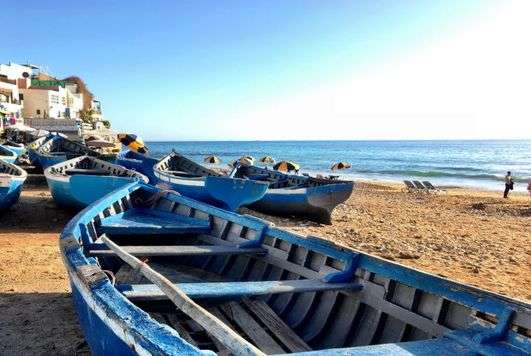
Small trawlers
Many of them made of wood, as well as motorized dinghies, ply the coastal waters as far out to sea as the edge of the Continental Shelf. Their catches consist of many different species of fish.
The fish market
At Agadir is one of the largest sardine ports in the world. An auction, which sells almost 250 different kinds of fish, takes place here every day.
Crates of fish
Are packed ready for sale. Sardines are the most important catch, but other fish, including hake and grey mullet, are also on offer.