RABAT
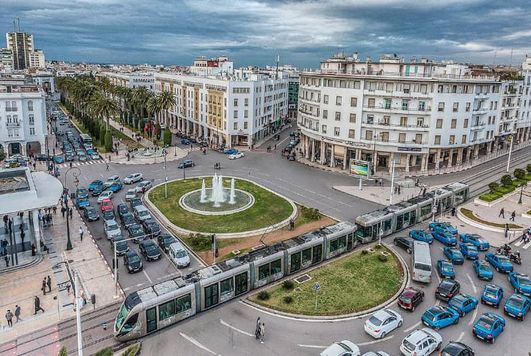
Facing into the Atlantic Ocean, It is an attractive city of domes and minarets, sweeping terraces, wide avenues and green spaces.
It is markedly more pleasant than some other Moroccan cities and is also undergoing fundamental change. Facing Salé, its ancient rival, across Wadi Bou Regreg.
Rabat is the political, administrative and financial capital of Morocco, the country’s main university town and its second-largest metropolis after Casablanca. Archaeological excavations of the Merinid necropolis at Chellah have shown that this area was occupied by the Romans, and even earlier too.
Much later, around 1150, Abd el-Moumen, the first ruler of the Almohad dynasty, chose to establish a permanent camp here and ordered a small imperial residence to be built on the site of a former ribat (fortified monastery). The caliph Yacoub el-Mansour then embarked on the construction of a great and splendid city that was to be known as Ribat el-Fath (Camp of Victory), in celebration of his victory over Alfonso VIII of Castile at the Battle of Alarcos in 1195. On the death of the caliph in 1199, work on this ambitious project ceased: although the city gates and walls had been completed, the Hassan Mosque and its minaret were unfinished. The Almohads’ defeat at linking Sala Colonia (known today as Chellah, see and Banasa, Lixus and Tangier.
This is the heart of one of earliest regions of Morocco in which towns and cities were established. The ocean has shaped the history of the coastal towns: occupied from Phoenician times and into the Roman period, they have attracted pirates, invaders and Andalusian, Spanish and French occupiers, each of whom left their mark.
It is also the ocean that gives the region its gentle, moist climate (strawberries, bananas and tomatoes are grown in greenhouses) and that drives industry and port activity from Kenitra to Tangier, where a port has been built to handle cargo bound for Europe.
Exploring RABAT
Rabat has four main areas of interest. In the north is the picturesque Oudaïa Kasbah, which is partly enclosed by ramparts dating from the Almohad period. The medina, which contains the city’s souks, is bounded to the west by Almohad ramparts and to the south by the 17th-century Andalusian Wall, which runs parallel to Boulevard Hassan II.
Avenue Mohammed V is the new town’s busy central north-south axis, with residential blocks dating from the Protectorate (1912-56). In the northeast stands the Hassan Tower and Mausoleum of Mohammed V. In the Merinid necropolis at Chellah, to the south, are vestiges of the Roman town of Sala.
Ramparts
City Walls Separated from the medina by the Place du Souk el-Ghezel, the Oudaïa Kasbah is defended by thick ramparts.
These were built mostly by the Almohads in the 12th century, and were restored and remodelled in the 17th and 18th centuries by the Moriscos and the Alaouite kings. Most of the Almohad walls that face onto the sea and run inland survive.

The walls surrounding the Andalusian Garden date from the reign of Moulay Rachid (founder of the Alaouite dynasty). The Hornacheros (Andalusian emigrants) who occupied the kasbah and rebuffed attacks from both sea and land rebuilt the curtain wall in several places and constructed the Pirates’ Tower, whose inner stairway leads down to the river.
They also pierced the walls of the old Almohad towers with embrasures to hold cannons. A complex system of underground passages leading from within the kasbah to the exterior beyond the walls was also dug.
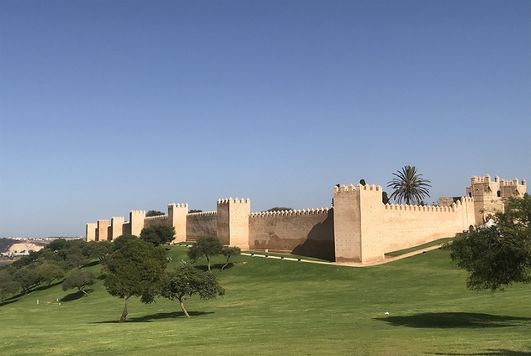
The city walls are built of rough-hewn stone covered with a thick coating of ochre plaster. They are set with imposing towers and bastions, which are more numerous along the stretch of the walls facing the sea and the river.
Standing 8 to 10 m (26 to 33 ft) high, and having an average thickness of 2.50 m (8 ft), the walls are surmounted by a rampart walk bordered by a low parapet; part of the rampart walk survives.
This sturdy building and sophisticated military construction defended the pirates’ nest and withstood almost all attacks from European forces.
Oudaïa Kasbah
The kasbah takes its name from the Oudaïas, an Arab tribe with a warrior past that was settled here by Moulay Ismaïl (1672-1727) to protect the city from the threat of rebel tribes.

Part of the city walls that surround this “fortress” , built on the top of a cliff, and Bab Oudaïa, the gate that pierces it, date from the Almohad period (1147-1248). On Rue Jamaa, the main thoroughfare of this picturesque district, stands the El-Atika Mosque, built in the 12th century and the oldest mosque in Rabat.
Bab Oudaïa
Bab Oudaïa Oudaïa Kasbah. The gate leads to the kasbah from Place du Souk el-Ghezel.
Towering above the cliffs that line the Bou Regreg, and dominating Rabat’s medina is Bab Oudaïa, which is the main entrance into the kasbah.
This monumental city gate, built in dressed stone of red ochre, is considered to be one of the finest examples of Almohad architecture.
But the particular design and conception of this gateway, built by Yacoub el-Mansour in 1195, make it more of a decorative feature than a piece of military defence work. Flanked by two towers, it is crowned by a horseshoe arch.
The inner and outer façades are decorated with rich ornamentation carved in relief into the stone, starting at the opening of the arch and continuing in several tiers as far up as the base of the parapet.
Above the arch, two bands with interlacing lozenges are outlined with floral decoration.
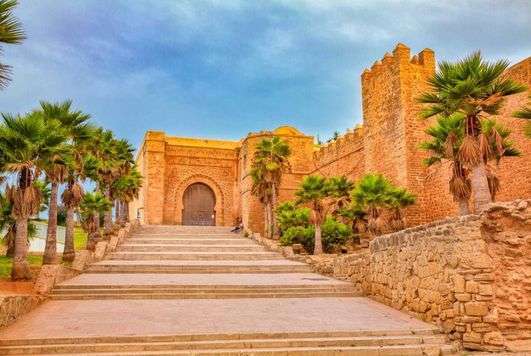
Both sides of the gate are crowned by a band of calligraphy. As in all Moorish palaces, the gatehouse of the former Oudaia Palace was also a defensive feature and a tribunal. Today, the gatehouse serves as an exhibition hall.
Oudaïa Museum
Musée des Oudaïa In the 17th century, Moulay Ismail built a small palace within the kasbah.
This became the residence of the first Alaouite sultans while they were based in Rabat, as an inscription on the wooden lintels of the central patio indicates: “Unfailing fortune and brilliant victory to our lord Smail, leader of the faithful.

“The palace was completely restored and slightly altered in 1917, during the Protectorate, and has undergone further phases of restoration, as well as a renovation since then.
The palace as it is today consists of a main building arranged around an arcaded courtyard. The four sides of the courtyard lead off into large rectangular rooms with marble floors and geometrically coffered ceilings.
The surrounding buildings include a prayer room for private workship, a hammam (steam bath) and a tower. A beautiful garden laid out in the Andalusian style gives the palace the status of a princely residence. Since 1915, the palace has housed the Musée des Oudaïa. On display here is an extensive collection of jewellery, including traditional pieces fashioned by Berber families.
There are also displays of woodcarvings, carpets and copperwork, astrolabes (for measuring the altitude of stars) dating from the 14th and 17th centuries, and collections of ceramics and of musical instruments.
One room in the museum is laid out as a traditional Moroccan interior, with sofas covered in sumptuous gold-embroidered silk fabrics made in Fès. Another room is devoted to the traditional dress of the region between the Rif and the Sahara.
Andalusian Walls
Andalusian Wall In the 17th century, the Moriscos – Muslim refugees from Andalusia – found the medina undefended and so encircled it with a defensive wall.
Named after its builders, the Andalusian Wall stands about 5 m (16 ft) high and runs in a straight line for more than 1,400 m (4,595 ft) from Bab el-Had (Sunday Gate) in the west to the borj (small fort) of Sidi Makhlouf in the east. Boulevard Hassan II runs parallel to it.
During the Protectorate, a stretch of the walls about 100 m (328 ft) long, and including Bab el-Tben, was destroyed to allow easier access to a market. The walls are set with towers placed at intervals of some 35 m (115 ft) and are topped by a rampart walk.
This is protected by a parapet that the Andalusians pierced with numerous narrow slits known as loopholes. To the east of the walls they built the Bastion Sidi Makhlouf , a small, irregular fort which consists of a platform resting on solid foundations, with a tower close by.
They also built embrasures over two of the Almohad gates, Bab el-Alou and Bab el-Had. Bab el-Had was once the main gateway into the medina. Dating from the Almohad period (1147-1248), it was rebuilt by Moulay Sliman in 1814.

On the side facing Boulevard Misr , one of gate’s two pentagonal towers stands close to the Almohad walls, which probably date from 1197 Bab el-Had contains several small chambers which were intended to accommodate the soldiers who were in charge of the guard, the armouries and the billetting of the troops.
Bab el-Rouah
Bab el-Rouah A sturdy and imposing Almohad gateway, Bab el-Rouah, the Gate of the Winds, dates from the same period as Bab Oudaïa

The entrance is decorated with the outline of two horseshoe arches carved into the stone and surrounded by a band of Kufic calligraphy. The interior of the gate contains four rooms with elegant domes. These rooms are now used for exhibitions.
Hassan Tower
Hassan Tower For more than eight centuries, the Hassan Tower has stood on the hill overlooking Wadi Bou Regreg. Best seen as one approaches Rabat by the bridge from Salé, it is one of the city’s most prestigious monuments and a great emblem of Rabat.
It is the unfinished minaret of the Hassan Mosque, built by Yacoub el-Mansour in about 1196. The construction of this gigantic mosque, of dimensions quite out of proportion to the population of Rabat at the time, suggests that the Almohad ruler intended to make Rabat his new imperial capital. An alternative interpretation is that the Almohads were attempting to rival the magnificent Great Mosque of Córdoba, the former capital of the Islamic kingdom in the West.

Either way, after the death of Yacoub el-Mansour in 1199, the unfinished mosque fell into disrepair. All but the mosque’s minaret was destroyed by an earthquake in 1755. The Hassan Mosque was built to a huge rectangular plan 183 m (600 ft) by 139 m (456 ft); the Great Mosque of Córdoba was just 175 m (574 ft) by 128 m 1 (420 ft).
It was the largest religious building in the Muslim West, in size inferior only to the mosque of Samarra in Iraq, A great courtyard lay at the foot of the tower, while the huge columned prayer hall was divided into 21 avenues separated by lines of gigantic columns crowned with capitals.
Remains of these imposing stone columns survive and still convey an impression of infinite grandeur. The minaret, a square-sided tower about 16 m (52 ft) wide and 44 m (144 ft) high, was to have surpassed the height of the Koutoubia Mosque and the Giralda in Seville, but it was never completed.
According to Almohad custom, it would have reached 80 m (262 ft), including the lantern. Even unfinished it seems huge. Each of its four sides is decorated with blind lobed arches. Onthe topmost level of the minaret extended interlacing arches form a sebkha motif (lozenge-shaped blind fretwork) as on the Giralda of Seville.
The interior is divided into six levels, each of which consists of a domed room. The levels are linked and accessed by a continuous ramp. It was from the Hassan Tower that Mohammed V conducted the first Friday prayers after independence was declared.
Mohammed V Mausoleum
Mausoleum of Mohammed V Raised in memory of Mohammed V, the father of Moroccan independence, this majestic building was commissioned by his son, Hassan II.It was designed by the Vietnamese architect Vo Toan and built with the help of 400 Moroccan craftsmen.

The group of buildings that make up the mausoleum of Mohammed V include a mosque and a museum devoted to the history of the Alaouite dynasty. The mausoleum itself, in white Italian marble, stands on a platform 3.5 m (11.5 ft) high. Entry is through a wroughtiron door that opens onto a stairway leading to the dome, beneath which lies the sarcophagus of Mohammed V.
Dar El Makhzan
Dar el-Makhzen An extensive complex enclosed within its own walls, the Dar el-Makhzen (royal palace) is inhabited by about 2,000 people.
Built on the site of an 18th-century royal residence, the current palace was completed in 1864, but was constantly enlarged thereafter; today, it even includes a racecourse.

The palace now houses the offices of the Moroccan government, the Supreme Court, the prime minister’s offices, the ministry of the Habous (responsible for religious organizations), and the El-Fas Mosque.
The méchouar, a place of public assembly, is the venue for major and important gatherings, including the bayaa, a ceremony at which senior government ministers swear their allegiance to the king.
Traditionally, the king would reside in the former harem though Mohammed VI stays in his own private residence. Besides private buildings, the palace also includes an extensive garden, immaculately kept and planted with various species of trees and with flowers in formal beds.
During the Protectorate, a stretch of the walls about 100 m (328 ft) long, and including Bab el-Tben, was destroyed to allow easier access to a market. The walls are set with towers placed at intervals of some 35 m (115 ft) and are topped by a rampart walk.
Chellah Necropolis
Access to the Chellah Necropolis is via Bab Zaer. This gate, named after a local tribe, was the only one on the southern side of the ramparts built by Yacoub el-Mansour. The necropolis is nearby. The entrance to the necropolis itself is marked by an imposing Almohad gate with a horseshoe arch flanked by two towers.
Above the arch is a band of Kufic calligraphy with the name of its builder, Abou el-Hassan, and the date 1339. On the left, inside a former guardhouse, there is a café. Through the gate, a stepped walkway leads to a terrace offering spectacular views of the Bou Regreg valley, the Merinid necropolis and the remains of the Roman town of Sala Colonia, which are surrounded by lush vegetation.
It was Abou Yacoub Youssef, the first Merinid caliph, who chose this as the site of a mosque and the burial place of his wife, Oum el-Izz, in 1284. Abou Yacoub Youssef died in Algeciras in 1286, and his body was brought back to the necropolis. His two successors, Abou Yacoub, who died in 1307, and Abou Thabit, who died in 1308, were also laid to rest here. The burial complex was completed by the sultan Abou Said (131031) and his son Abou el-Hassan (1331-51), and was later embellished by Abou Inan.
The walls around the necropolis, which have the ochre tones typical of the earth stone of Rabat, were built by Abou elHassan, who probably reconstructed the existing Roman walls. In 1500,Leo Africanus recorded the existence of 30 Merinid tombs, Situated within the walls of the necropolis are the ruins of the mosque built by Abou Youssef and of the buildings that surrounded it.
To the right behind the mihrab is the koubba (shrine) of Abou Yacoub Youssef Opposite the koubba, the Mausoleum of Abou el-Hassan, the Black Sultan and the last Merinid ruler to be buried here, in 1351, lies alongside the walls. His funerary stele is still in place.
Also to be seen here is the koubba of his wife, who died in 1349. Named Chams el-Doha (which can be translated as “light of the dawn”), she was a Christian who converted to Islam. She was the mother of Abou Inan, one of the most illustrious Merinid rulers. Her accomplishments include the building of the Bou Inania Medersa in Fès.
Also within the walls of the necropolis was a zaouia, a religious institution that functioned simultaneously as a mosque, a centre of learning and a hostel for pilgrims and students (some of the cells can still be made out). Built by Abou el-Hassan, the zaouia is designed and decorated like the medersas in Fès, and it is thought that it may have been even more luxuriously appointed. Abou el-Hassan covered the upper part of the minaret with a decorative design of white, black, green and blue zellij tilework, which is still visible today.
The necropolis has become the subject of much folklore and many legends, as can be seen from the large number of marabouts (shrines) of holy men that are scattered about the garden. The sacred eels in the fountain (once the ablutions fountain for the mosque) are also believed to bring good fortune to barren women. These supplicants feed them eggs, symbols of fertility, which are offered for sale by young boys in the square. Environs Archaeological excavations at Chellah have uncovered the remains of the major buildings of Sala Colonia.
Once a prosperous Roman city, Sala Colonia later declined and by the 10th century had fallen into ruin. Still visible today is the decumanus maximus, the main thoroughfare that crossed all Roman cities from east to west. it led out from Sala Colonia to the port, built in the 1st century BC and now buried in sand. From the forum, a road to the right leads towards the Merinid necropolis.
Archeology Museum
Musée Archéologique The most extensive collection of archaeological artifacts in the country is housed in the Musée Archéologique.

The museum building was constructed in the 1930s, to house the Antiquities Services.
The initial prehistoric and pre-Islamic collections, consisting of objects discovered by archaeologists working in Volubilis, Banasa and Thamusida, were put on public display for the first time in 1930–32.
The addition of further material from Volubilis in 1957 considerably enlarged the museum’s collections, raising it to the status of a national museum. The displays present the collections according to historical period.
These range from the prehistoric period up to the findings of recent archaeological excavations.
Ville Nouvelle
During the 44 years of the Protectorate, Marshal Lyautey and the architects Prost and Ecochard built a new town in the empty part of the extensive area enclosed by the Almohad walls.
Laying out wide boulevards and green spaces, they created a relatively pleasant town.
The avenue is lined with residential blocks in the Hispano-Maghrebi style. Avenue Mohammed V, the main avenue, runs from the medina to the El-Souna Mosque, or Great Mosque, which was built by Sidi Mohammed in the 18th century.
They were built by the administration of the Protectorate, as were the Bank of Morocco, the post office, the parliament building and the railway station.
The Bank of Morocco also houses the Musée de la Monnaie (Coin Museum). Rue Abou Inan leads to the Cathédrale Saint-Pierre, a pure white building dating from the 1930s.