CASABLANCA
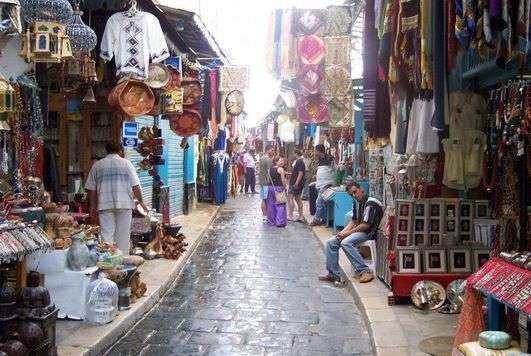
The commercial and financial capital of Morocco, is a baffling metropolis where tradition and modernity co-exist. A city where skyscrapers stand in stark contrast to the small shops of the medina, with its narrow, winding streets, this is where the prosperous rub shoulders with paupers.
In the 7th century, Casablanca was no more than a small Berber settlement clinging to the slopes of the Anfa hills.However, for strategic and commercial reasons, it was already attracting the attention of foreign powers.
In 1468, the town was sacked by the Portuguese, who wrought wholesale destruction on the city’s privateer ships.
Then, in the 18th century, with the sultanate of Sidi Mohammed ben Abdallah, Dar el-Beïda (meaning “White House” – “Casa Blanca” in Spanish) acquired a new significance. This was thanks to its harbour, which played a pivotal role in the sugar, tea, wool and corn markets of the Western world.
But it was in the 20th century, under the French Protectorate, that Casablanca underwent the most profound change. Against expert advice, Marshal Lyautey, the first residentgovernor, proceeded with plans to make Casablanca the country’s economic hub. To realize this vision, he hired the services of town planners and modernized the port. For almost 40 years, the most innovative architects worked on this huge building project.
Casablanca continued to expand even after independence. Futuristic highrise buildings and a colossal mosque sending its laser beams towards Mecca once again expressed the city’s forwardlooking spirit. With about 4 million inhabitants, and a further 5 million in the perfecture, Casablanca is, today, one of the four largest metropolises on the African continent, and its port is the busiest in Morocco
Exploring CASABLANCA
The centre of the new town (Ville Nouvelle) revolves around two focal points: the Place des Nations Unies and the Place Mohammed V, squares that are lined with fine 1930s buildings. To the north, the old medina is still enclosed within ramparts, while the Parc de la Ligue Arabe, Casablanca’s green lung, extends to the southeast. Further out, towards the west, is the residential district of Anfa the coastal resort of Aïn Diab. The Boulevard de la Corniche leads to the monumental Hassan II Mosque. The Quartier Habous, a modern medina built in the 1920s, also features, some interesting architecture.
Hassan II Mosque
With a prayer hall that can accommodate 25,000, the Hassan II Mosque is the second-largest religious building in the world after the mosque in Mecca. The complex covers 9 hectares (968,774 sq ft), two-thirds of it built over the sea.
The minaret, the lighthouse of Islam, is 200 m (656 ft) high, and two laser beams reaching over a distance of 30 km (18.5 miles) shine in the direction of Mecca. The building was designed by Michel Pinseau, 35,000 craftsmen worked on it, and it opened in 1993. With carved stucco, zellij tilework, a painted cedar ceiling and marble, onyx and travertine cladding, it is a monument to Moroccan architectural virtuosity and craftsmanship.
The Minaret
Its size – 25 m (82 ft) wide and 200 m (656 ft) high- and its decoration make this an exceptional building.
Fountains
These are decorated with zellij tilework and framed with marble arches and columns.
Marble
Covering the columns of the prayer hall and seen on doorways, fountains and stairs, marble is ubiquitous, sometimes used in combination with granite and onyx.
Doors
Seen from the exterior, these are double doors in the shape of pointed arches framed by columns. Many are clad in incised bronze.

Minbar
The minbar, or pulpit, located at the western end of the prayer hall, is particularly ornate. It is decorated with verses from the Koran.
Women’s Gallery
Above two mezzanines and hidden from view, this gallery extends over 5,300 sq m (57,000 sq ft) and can hold up to 5,000 women.
Dome
The cedar-panelled interior of the dome over the prayer hall glistens with carved and painted decoration.
Royal Door
This is decorated with traditional motifs engraved on brass and titanium.
Prayer Hall
Able to hold 25,000 faithful, the prayer hall measures 200 m (656 ft) by 100 m (328 ft). The central part of the roof can be opened to the sky.
The Stairway
Features decorative woodcarving, multiple arches and marble, granite and onyx columns, arranged in a harmonious ensemble.
Habous Quarter
In the 1930s, in order to address the problem of an expanding urban population and to prevent Casablanca’s underprivileged citizens from being forced to settle in insalubrious quarters, French town planners laid out a new medina (Nouvelle Medina). Land to the south of the existing city centre earmarked for this development was given over to the Habous, the administration of religious foundations, hence the new town’s name.
This new town – which did not, however, forestall the later development of shanty towns – was built in the traditional Arab style at the same time as obeying modern town planning and public health regulations. It contains public areas, such as a market, shops, mosques, a kissaria and baths, as well as private dwellings (arranged around a courtyard separated from the street by a solid wall).

Northeast of the medina are the copperThe new medina is another facet of colonial town planning during the Protectorate, and its flower-filled, arcaded streets offer the opportunity for a stroll in a scenic quarter of the city. While the most modest houses are located around the market, the finest are set around the mosque, and brass Souk and famous patisserie, which sells pastrie.
Known as cores de gazelle (gazelles’ horns), fritters and pastilla. There are also shops specializing in curios and collectors’ items, and they can be good places to find Art Deco objects. A wide range of Moroccan rugs and carpets is also on sale at the weekly auction in the carpet souk.
Northwest of the Quartier Habous, Mahakma du Pacha, a formal tribunal and today one of the city’s eight préfectures (administrative headquarters). The building (by A. Cadet, 1952), which centres around a tall tower and two courtyards, is a fine example of the adaptation of traditional Arab architecture to modern needs.
The traditional Arabic decoration of its 64 rooms is the work of Moroccan craftsmen: it consists of carved stucco and zellij tilework on the walls, carved cedarwood panels on the ceiling and wrought iron on the doors.
The Royal Palace, on the fringes of the Quartier des Habous and set in extensive Mediterranean gardens, was built in the 1920s by the Pertuzio brothers, whose aim was to create a luxuriously appointed yet modern dwelling.
Mohammed V Square
Exemplifying the architecture of the Protectorate, this square, the administrative hear3t of Casablanca, combines the monumentality of French architecture with Moorish sobriety.
This is the location of the Préfecture, the law courts, the central post office, banks and cultural organizations The Préfecture (by M. Boyer, 1937), over which towers a Tuscanstyle campanile 50 m (164 ft) high, stands on the southeastern side of the square. Its buildings are set around three courtyards, each with a tropical garden.
The central stairway is framed by two huge paintings by Jacques Majorelle depicting the festivities of a moussem and the performance of the ahwach, a Berber dance. Behind stands the Palais de Justice (law courts, designed by J. Marrast and completed in 1922).
The strong verticality of the Moorish doorway, with its awning of green tiles, contrasts with the horizontal lines of the arcaded gallery, which are emphasized by a carved frieze running the length of the building. Two buildings set slightly back abut the facade of the law courts on either side.
On the right is the Consulat de France (French Consulate, by A. Laprade, 1916), whose gardens contain an equestrian statue of Marshal Lyautey, by Cogné (1938), which stood in the centre of the square until Moroccan independence. On the left, in the northeastern corner, is the Cercle Militaire (by M. Boyer).

Along Rue de Paris, a small area of greenery where people like to stroll gives a more picturesque feel to the square, in the centre of which is a monumental fountain dating from 1976. At certain times of day, the fountain plays music and gives light displays.
United Nations Square
At the beginning of the 20th century, this was still no more than a market square, a place which, by evening, would become the haunt of storytellers and snake charmers.
Today, it is the heart of the new town, a hub where major thoroughfares converge. When the square was laid out in 1920, it was known as Place de France, but was later renamed. Beneath the arcades of 1930s apartment blocks are rows of brasserie terraces and souvenir shops.

In the northeast corner of the square, the clocktower, which dates from 1910, was demolished in 1940 and then rebuilt to an identical design. At the time that it was built, the clock symbolized colonial rule, indicating to the population that it should now keep in time with an industrial society.
At the Hyatt Regency Hotel memories of Humphrey Bogart and Ingrid Bergman, stars of the famous film Casablanca, made in 1943 by Michael Curtiz, hang on the walls. In the southeast corner of the square is the Excelsior Hotel , with Moorish friezes and balconies, which was the first of Morocco’s Art Deco hotelsand is one of the square’s finest buildings.
In 1934, the 11-storey Moretti Milone apartment block, at the corner of Boulevard Houphouët Boigny, was the first high-rise building in central Casablanca. Boulevard Houphouët Boigny, lined with shops and restaurants.
At the end, on the right, the marabout of Sidi Belyout, patron saint and protector of Casablanca, stands in stark contrast to the neighbouring residential buildings.
Old Medina
At the beginning of the 20th century, Casablanca consisted only of the old medina, which itself comprised no more than a few thousand inhabitants. The walls around the old town were originally pierced by four gates, two of which survive today.
Bab Marrakech and Bab el-Jedid, on the western side, face onto Boulevard Tahar el-Alaoui. A daily market, with jewellers, barbers, public letterwriters and so on, stretches out along the length of the walls.
Opposite the fishing harbour is the sqala, a fortified bastion built in the 18th century, during the reign of Sidi Mohammed ben Abdallah.
Behind bastion, the marabout (shrine) with a double crown of merlons contains the Tomb of Sidi Allal el-Kairouani, who became Casablanca’s first patron saint in 1350. Bab el-Marsa (Gate of the Sea), which opens onto Boulevard des Almohades, also dates from the 18th century.
It was at this spot that the French disembarked in July 1907.
Arab League Parc
Laid out by the architect A. Laprade in 1919, this huge garden incorporates café terraces and is a popular place for a stroll. Avenues lined with impressively tall palm trees, ficus, arcades and pergolas frame some stunning formal flowerbeds.
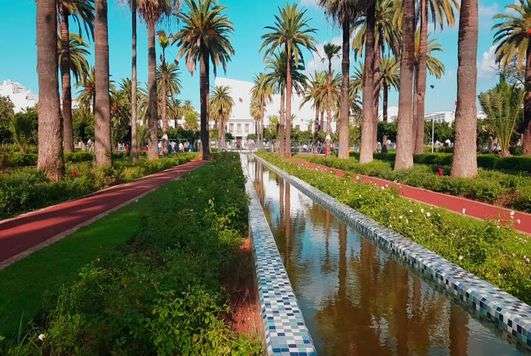
The streets surrounding the park, including Rue d’Alger, Rue du Parc and Boulevard Moulay-Youssef, contain Art Nouveau and Art Deco houses.
Northwest of the park stands the Église du Sacré-Coeur, built in 1930-52 by Paul Tournon. A white concrete twin-towered building with an Art Deco flavour to its façade, it is now deconsecrated and used for cultural events.
To the southeast stands the Église Notre-Dame-deLourdes (1956). Its stainedglass windows depict scenes from the life of the Virgin against motifs taken from Moroccan carpets.
They are the work of G. Loire, a master-craftsman from Charteres.to the southwest is villa des arts displaying contemporary Moroccan paintings.
Port
Casablanca is Morocco principal port, Covering an area of 1.8 sq km (0.70 miles), the port was built during the Protectorate and is one of the largest artificial ports in the world.
A groyne protects it from the pounding of the ocean that destroyed several earlier constructions.
The port is equipped with ultra-modern commercial, fishing and leisure facilities, Access to the port complex is via the fishing harbour.
On the seafront in the port itself , as well as along the avenue leading down to it, some excellent fish restaurants are to be found, A multi-million dirham development of towering hotels, restaurants, shops, offices and apartments, together with a marina, is changing the shoreline between the port and the Hassan II Mosque.
The first phase is due to be completed by 2015.

Anfa
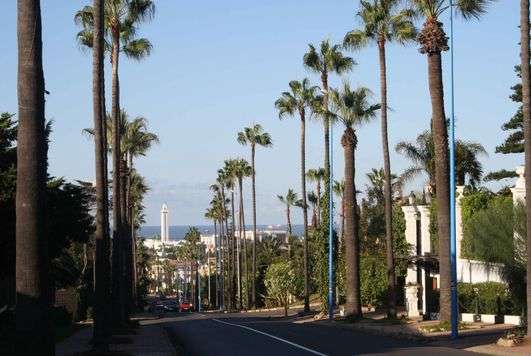
Occupying a hill that overlooks Casablanca from the northwest, Anfa is a residential quarter with wide flower-lined avenues where luxurious homes with terraces, swimming pools and lush gardens bring to mind Beverly Hills.
Although they got wind of the meeting, the Germans were misled by the literal translation of “Casablanca”.
Under the impression that the location was to be the White House in Washington, they failed to prevent it from going ahead.
During the meeting, President Roosevelt also formally pledged his support to Sultan Mohammed V in his aim to obtain independence from France, thus opening new avenues for Morocco in the postwar period.
Ain Diab Cornich
The Corniche d’Aïn Diab has been an upmarket part of Casablanca since the 1920s. Running from the ligh El-Hank Lighthouse (built in 1916)
In the east, to the marabout of Sidi Abderrahman in the west, this coastal avenue is lined with a succession of tidal swimming pools, hotels, restaurants, fashionable nightclubs and an institute of thalassotherapy.
The earliest establishments to be built here – with the needs of a wealthy clientèle in mind – opened in the 1930s. A string of public beach clubs, each one rivalling its neighbour, lines the Corniche, offering a variety of pools and restaurants.
The most modern and fashionable is the Tahiti Beach Club At the foot of the hill of Anfa, near the Palais Ibn Séoud, the foundation of the same name houses a mosque and one of the most comprehensive libraries on the African continent.

At the western end of the Corniche, 3 km (2 miles) further on, the Marabout of Sidi Abderrahman, perched on a rock, is accessible only at low tide. It attracts Muslim pilgrims suffering from nervous disorders and those who have had evil spells cast on them.
Jewish Museum
The modernized Museum of Moroccan Judaism contains displays of scarves, kaftans, prayer shawls and other religious objects, and a reconstructed synagogue. From Roman times up to independence in 1956, Morocco had a sizeable Jewish community.
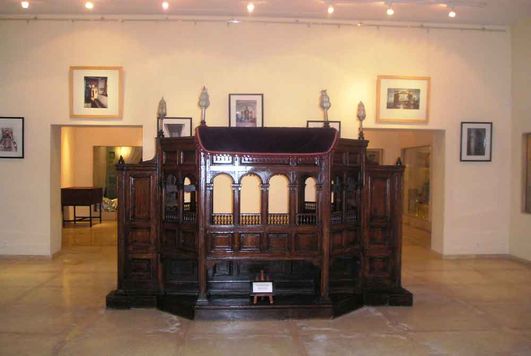
Today numbering some 5,000, Morocco’s Jews occupy prominent positions in the spheres of politics, economics and culture.